
Maximum pressure meets maximum distraction
Sanctions, regime change or just political theater?

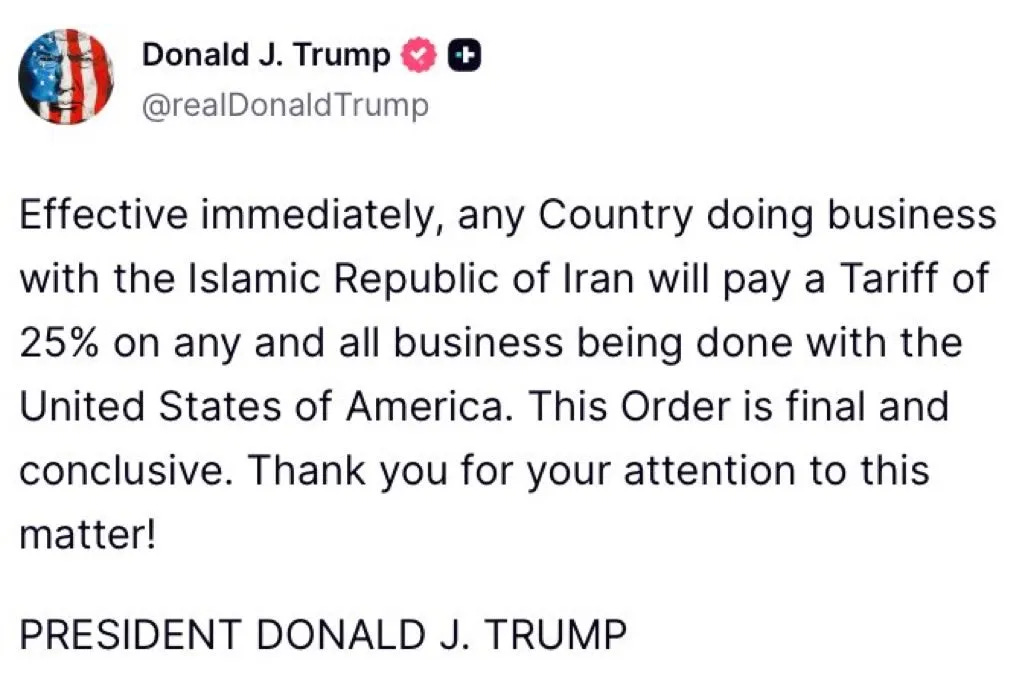
Trump announced it yesterday with his usual flair for the dramatic. “Effective immediately, any Country doing business with the Islamic Republic of Iran will pay a Tariff of 25% on any and all business being done with the United States of America.”
Final and conclusive. Thank you for your attention.
Except it’s neither final nor conclusive. It’s legally questionable, economically suicidal, and strategically moronic. But let’s start with the obvious problem: the Supreme Court is about to rule on whether Trump even has this authority. The ruling could drop as early as tomorrow. Lower courts have already said “no” to similar overreach. So Trump just issued an order that might get struck down within 24 hours.
That’s not strength. That’s desperation dressed up as decisiveness.
But let’s pretend for a moment that the Supreme Court lets this slide. What happens then? Well, Americans get to pay 25% more on $427 billion worth of annual imports from China alone. Electronics spike. Apparel jumps. Auto parts double. Similar tariffs in 2018-2020 reduced US GDP by 0.5% and raised consumer prices by 2.3%. American families faced thousands in added annual costs for the privilege of... what exactly? Making Iran slightly more inconvenient to trade with?
Because Iran isn’t paying this tariff. American importers are. American consumers are. The Trump administration is taxing Americans to punish countries that do business with Iran. It’s a sanctions own-goal wrapped in nationalist rhetoric.
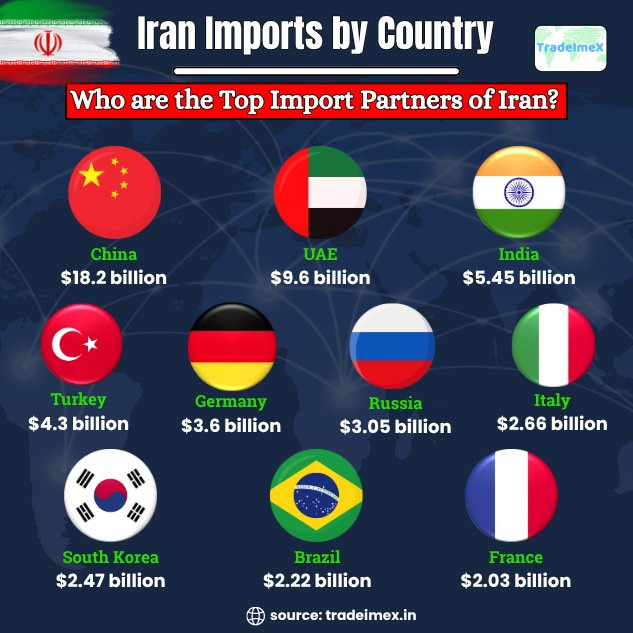
China buys 90% of Iranian oil. The UAE facilitates regional commerce. Turkey maintains strategic ties. Iraq shares a border and energy infrastructure. Germany, Japan, South Korea round out the list. Notice something? Most of these countries aren’t particularly dependent on US trade. China sure as hell isn’t going to sacrifice Iranian oil imports to keep selling cheap electronics to Walmart. The UAE isn’t going to crater its regional trade hub status because Washington threw a tantrum.
Iran’s crude oil exports to China alone hit 1,375,000 barrels recently - not despite sanctions, but in defiance of them. China routes purchases through third parties, teapot refineries, Hong Kong shell companies. Complex trade networks that the US Treasury can’t untangle even when it’s trying. Trump’s tariff announcement doesn’t change this infrastructure. It just makes it slightly more expensive to operate... for Americans.
The enforcement problem alone should kill this policy before it starts. How exactly does the US track “business with Iran” across global supply chains? China doesn’t publish its Iranian crude purchases in a spreadsheet for Washington’s convenience. The UAE doesn’t flag which transactions involve Iranian counterparties. Turkey doesn’t report its energy imports to the State Department. Trump’s tariff relies on information the US doesn’t have and cooperation from countries that won’t provide it.
So what actually happens? Companies adjust their paperwork. Transactions get routed through additional intermediaries. Trade continues while looking slightly different on customs forms. Iran keeps selling oil. China keeps buying it. The UAE keeps facilitating. And American consumers pay 25% more on imports because their government can’t tell the difference between sanctioned and non-sanctioned goods anymore.
But the real damage isn’t economic. It’s strategic.
Trump’s tariff forces every country doing business with Iran into a binary choice: Iranian trade or American market access. For China, that’s no choice at all - Iranian oil is strategic, American consumers are optional. For the UAE, regional stability trumps Washington’s demands. For Turkey, energy security matters more than diplomatic pressure. Even Germany, Japan, and South Korea - countries that might actually care about US market access - are getting crushed by Chinese competition in core industries. They’re already losing manufacturing dominance. Trump’s tariff just accelerates their decline while pushing them toward alternative trade arrangements.
This is how BRICS expansion happens. Not through grand geopolitical declarations, but through thousands of companies and dozens of countries gradually concluding that dollar-based trade isn’t worth the compliance costs anymore. Every secondary sanctions regime makes the alternative financial architecture more attractive. Every tariff threat pushes another country to diversify away from US-dominated systems. Trump thinks he’s isolating Iran. He’s isolating America.

I’ve documented this pattern before with Russian sanctions, Venezuelan pressure, and countless other “maximum leverage” campaigns that somehow ended with the US losing influence while targets found workarounds. The sanctions playbook doesn’t work anymore. It worked when the US was the only game in town, when dollar clearing was mandatory, when SWIFT access meant financial survival. That world is gone. Countries can trade in yuan, euros, gold, barter arrangements. They can route payments through Shanghai, Abu Dhabi, Istanbul. The infrastructure exists now. Trump’s tariff just gives them one more reason to use it.
And then there’s the timing.
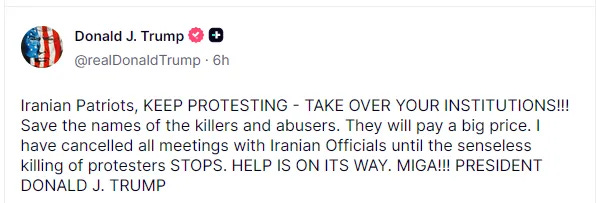
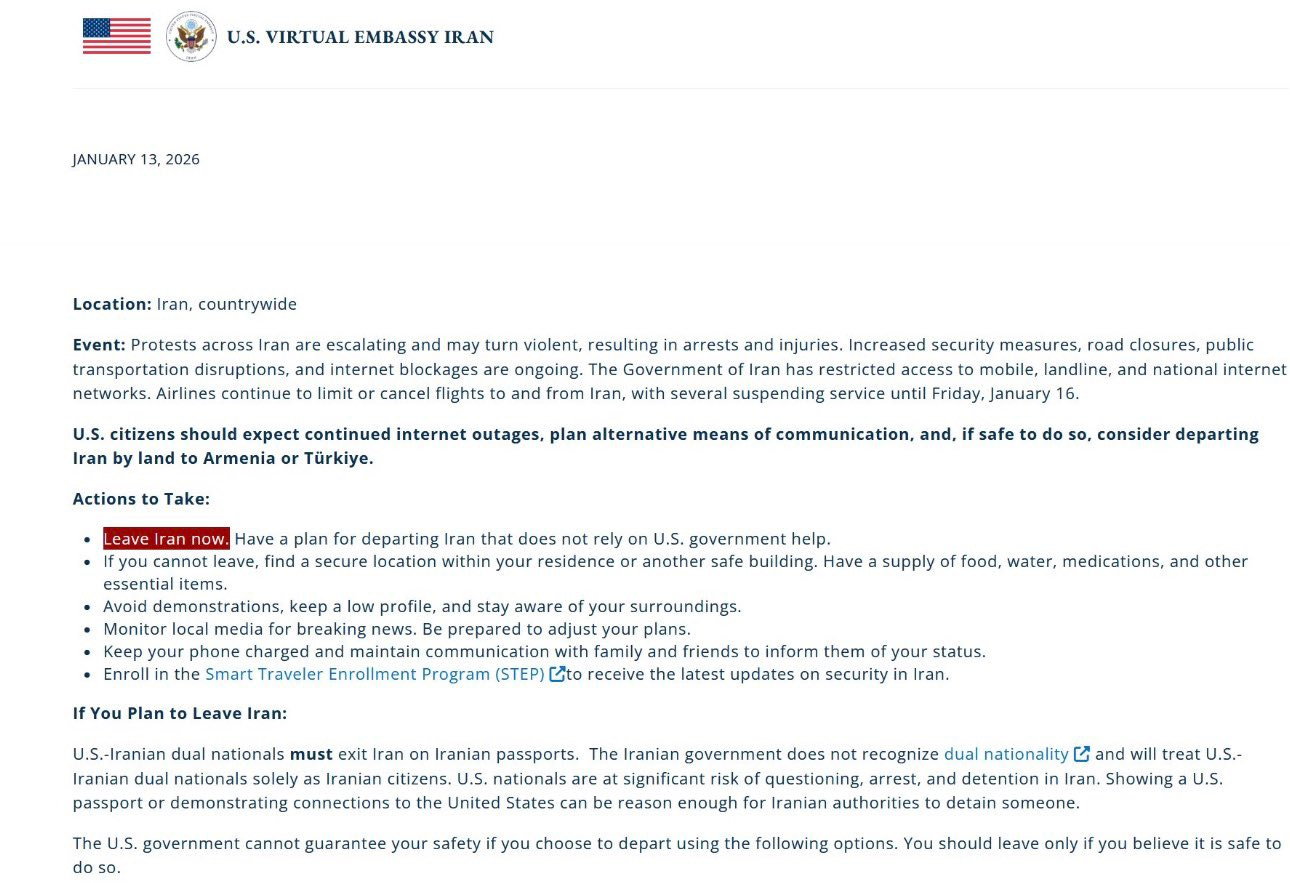
Supreme Court ruling on Trump’s tariff authority: January 14th. Trump issues Iran tariff: January 13th. 17h ago: The US embassy tells Americans in Iran to get out. Six hours ago, Trump posted another message directly to Iranian protesters: “KEEP PROTESTING - TAKE OVER YOUR INSTITUTIONS!!! [..] HELP IS ON ITS WAY.”
Help is on its way.
Not humanitarian aid. Not diplomatic pressure. Help. The kind that arrives on C-17 transports and MH-60 Black Hawks. The kind I documented being pre-positioned at RAF Fairford last week. Trump isn’t encouraging peaceful protests. He’s encouraging regime change. “Take over your institutions” isn’t democracy promotion. It’s operational guidance for a color revolution.

Either Trump has the worst timing in presidential history, or something’s being coordinated here. (see link above for more details)
An evacuation warning isn’t a precaution. It’s a signal. When the State Department tells Americans to leave a country, operations are imminent. Hours likely, not days. Trump wouldn’t issue evacuation orders for diplomatic leverage, right? Let’s give him the benefit of the doubt and assume he issues them so casualties can’t blame him for insufficient warning.
But the Supreme Court rules tomorrow on whether Trump even has the authority to impose these secondary tariffs. What better way to ensure nobody cares about a legal defeat than to have military operations dominating every news cycle by the time the decision drops? If the Court strikes down his tariff authority, Trump can pivot immediately to “helping Iranian protesters” while his economic overreach gets buried on page six. If the Court somehow lets it stand, he’s already created the crisis atmosphere that justifies emergency powers. Either way, he wins the narrative.
Create enough chaos across enough fronts that individual failures disappear into the noise. Venezuela extraction, FED investigations, Iran tariffs, evacuation orders, “help is on its way” tweets - each one generates its own crisis cycle that drowns out scrutiny of the previous move. By the time legal scholars finish analyzing whether Trump violated separation of powers with his tariff announcement, American forces will already be operating in Iran and the question becomes moot. You can’t challenge executive overreach when the president’s already at war.
Now inside Iran, and yeah we know they’re authoritarian, but even by those standards, this takes the biscuit… Iran went completely dark on January 8th.
And I mean completely off-grid.
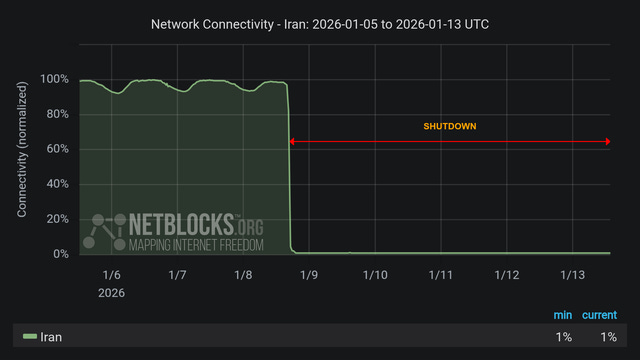
Not partially restricted. Not selectively throttled. Near-total internet shutdown affecting 85 million people. Mobile networks down. Phone lines cut. International connectivity flatlined at roughly 1% for over 120 hours now. NetBlocks monitoring confirmed the blackout hit exactly as protests entered their twelfth day. Banking apps stopped working. Ride-sharing services died. Even domestic networks went offline. The regime flipped the master switch and disconnected Iran from the world.
Even Starlink isn’t working anymore.
When Iran shut down internet during the Mahsa Amini protests in 2022, Starlink provided a workaround. Smuggled terminals let activists bypass government-controlled infrastructure. Same thing happened during the twelve-day war with Israel last summer - at least until the post-strike blackout when security forces went door-to-door hunting collaborators. Starlink was the fail-safe - low-earth orbit satellites that authoritarian regimes supposedly couldn’t jam.
But now? Tehran succeeded where Moscow couldn’t.
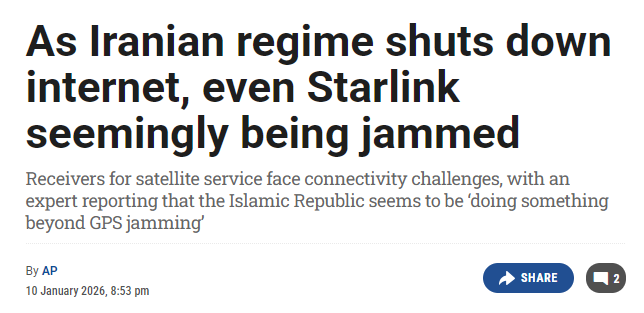
Iran deployed military-grade GPS jammers - likely Russian or Chinese technology - that are systematically crippling Starlink performance. Amir Rashidi, director of digital rights at the Miaan Group, said he detected 30% packet loss initially on January 8th. By that evening, some areas hit 80% degradation. By January 11th, Iran effectively shut down Starlink for the first time ever.
“This kind of interference, caused by military equipment known as jammers, had never been witnessed in my 20 years of research.”
— Rashidi
SpaceX activated free Starlink service at Trump’s request. Musk supposedly came through for the protesters. Except it doesn’t work. The 40,000-50,000 Starlink terminals scattered across Iran are largely useless now. Iran isn’t just jamming GPS signals. They’re using sophisticated mobile jammers that target the satellite uplink and downlink directly. Something beyond what Russia deployed in Ukraine. And unlike Ukraine, where SpaceX could push rapid software fixes, nothing’s coming for Iran.
Whether this started organic or not is irrelevant at this point. What matters is who’s steering it now and where it’s headed. Economic collapse creates opportunity. Internet blackout created desperation. Trump’s tweets create justification for intervention. The formula’s been used in Libya, Syria, Ukraine, Venezuela. Add Iran now to the list. The only question is whether Tehran’s government collapses before American forces arrive or gets united because they arrive.

And that is EXACTLY what Netanyahu’s been pushing for this. Ever since he got his ass handed to him by “a bunch of desert nomads” (aka the 12-day war). The June 2025 outcome is strategically unacceptable to his concept of regional dominance. He needs Iran’s missile production capacity destroyed, not degraded. That requires sustained strikes. Real war, not managed spectacle.
The protests create the perfect cover. Internal chaos plus brutal suppression equals American military intervention marketed as humanitarian rescue. Trump can claim he’s saving protesters from massacre while Netanyahu gets his strikes on missile facilities. And so what that the tariff’s decision is drowned out of the news cycle?
The information blackout ensures nobody can contradict whatever narrative gets sold to Western audiences afterward. Iran’s jamming success against Starlink - which should terrify every analyst watching - becomes strategically useful. Can’t show massacre footage if nobody can transmit it.
Meanwhile, the tariff announcement ensures that whatever happens militarily, America’s already lost the economic war. All parties are accelerating plans to trade outside the dollar systems, coordinate through alternative institutions, build financial infrastructure that doesn’t require Washington’s permission. Trump’s tariff just made that transition more urgent and more justified.
So we’re back to the same question I keep asking about every sanctions regime: who’s actually being isolated here?
Trump calls this “maximum pressure”. Netanyahu calls it strategic necessity. I call it the final spasms of an empire that can’t accept it’s no longer calling the shots. The dollar’s reserve status is already eroding. Trump’s tariff doesn’t reverse these trends. It accelerates them while making Americans poorer in the process.
And sometime in the next 48 hours, probably while the Supreme Court is still drafting its opinion on whether Trump even had authority to issue this tariff, something might happen in Iran that makes the whole legal question moot. Maybe it’s the buildup in forces I documented being prepared for some mostly peaceful bombings. Maybe it’s the Iranian regime that collapses. Maybe it’s something worse.
But when Americans get told to evacuate the country, when Trump announces crushing tariffs against anyone trading with that country, tweets that “help is on its way” to protesters trying to “take over institutions”, and does it all while being under an information blackout that even Starlink can’t penetrate...
You don’t need classified intelligence to read these signals.
Either something’s about to happen, or Trump just proved he’ll weaponize war signals for domestic political theater.
I can’t decide which possibility is worse.
Glad there are some others who understand the basic concept that consumers eat most of any tariff directly. Indirectly? Layoffs and benefits/salary stagnation, lower quality, shrinkflation, and so forth.
Iran is poised for a "maximal" missile strike on Israel.
One might wonder if that includes Israeli nuclear targets or not.
Israel has the Samson Option policy, that it will unleash all nukes on foe and friends alike if it is existentially threatened. It came close to that point during the Yom Kippur War in 1973.
Golda and Moshe were sweating bullets.
Iran can't reasonably take out all Israeli subs with nuclear missiles, so Iran expects to get nuked, but they might soon get nuked anyway...
How much help might Russia and/or China provide in defending against the Israeli nuclear attack?
Would it matter if Iran or Israel attacked first? Russia can turn their air defenses off remotely, as they did with Syria often enough.
Razor's edge and hair-trigger & stuff...