
Blockading the blockade
When you can’t open a door, board it up and call it strategy

Arleigh Burke was an American admiral in World War 2. Decorated, brilliant, the kind of naval officer they name things after. They named an entire class of destroyer after him - the DDG-51. It’s the workhorse of the US Navy, the ship that does the actual work while aircraft carriers pose for photographs. There are currently about 15 of them within striking distance of the Strait of Hormuz.
I want you to remember that name, because before this blockade is over, an Arleigh Burke might be the most important ship in the world.
Or the most famous wreck.
Two blockades now sit on top of each other in the same 33-kilometre waterway. Iran has been running one since the start of the war. The US just stacked a second one on top, targeting Iranian ports specifically, as of 10 AM Eastern on Monday. The president wants you to believe this is checkmate. The Foundation for Defence of Democracies wants you to believe Iran folds in 13 days.
I’ve been covering this war daily since it started. The Bretton Whoops, Straight to Brrrr, and 20-something wrap-ups.
I’ve watched every escalation get framed as the move that finally ends it.
This one is no different in that respect.
But it is different in another, and it took me a while to put my finger on why: this is the first time the US has voluntarily made the problem worse in order to claim it’s making it better.
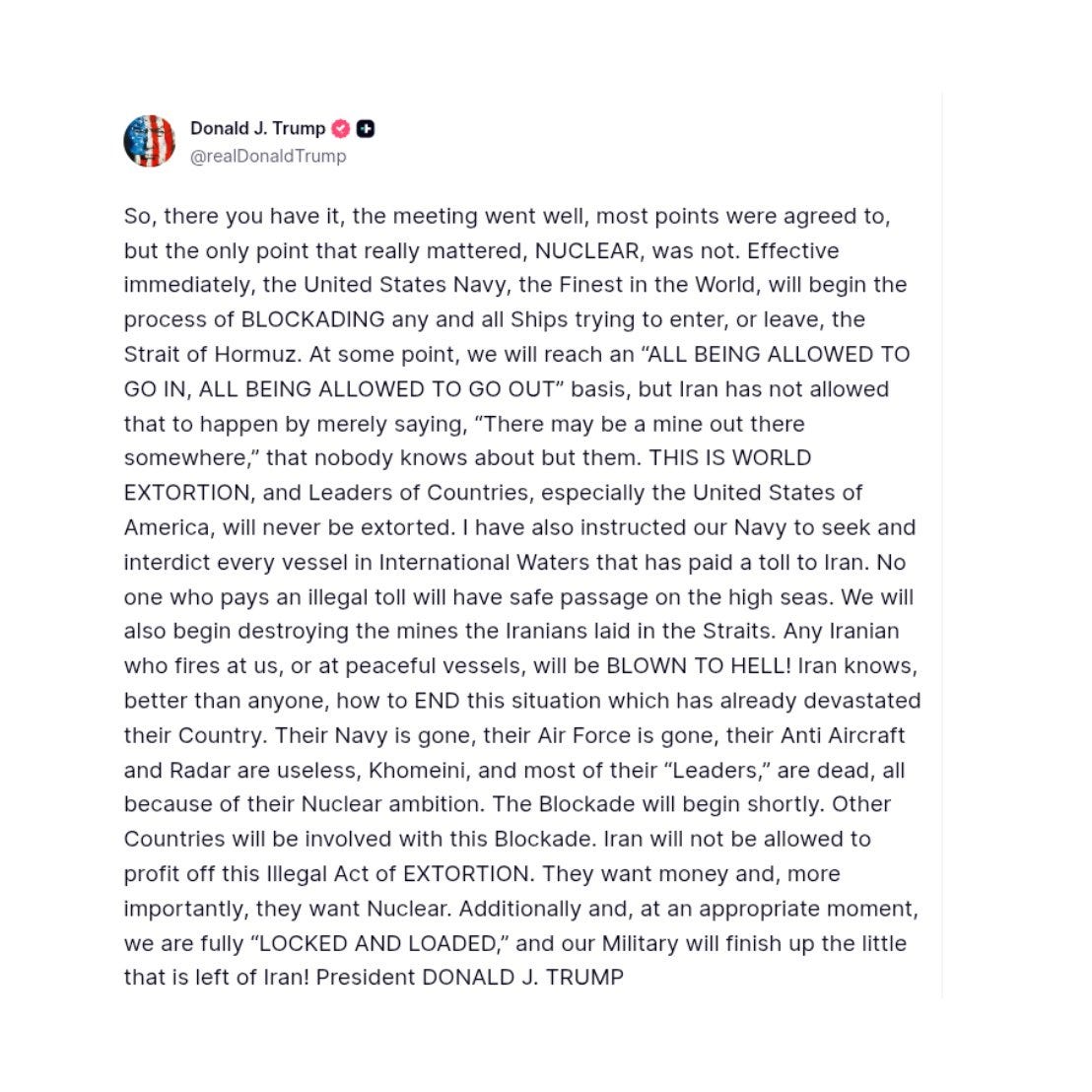
Trump posted on Truth Social that the US Navy would blockade “any and all Ships trying to enter, or leave, the Strait of Hormuz”. CENTCOM, as it does, translated the president’s rhetoric into something operationally coherent: the blockade applies to ships entering or exiting Iranian ports, not the entire strait. Ships heading to Dubai, Kuwait, Bahrain, Qatar - those are technically unaffected.
The gap between the presidential post and the military order is an ocean.
Literally.
Iran’s blockade was never total either. Chinese tankers have been transiting since day 1. Indian vessels negotiated passage. Pakistan escorted its own ships through with Chinese-built frigates. Malaysia got a waiver. Spain got through. Turkey got through. The strait wasn’t closed. It was a members-only club, and the membership criteria was not being allied with the people who started the war.
So now the US is running its own members-only club on top of Iran’s members-only club.
Two bouncers, same door, opposite guest lists.


The bullish case for this comes primarily from one man: Miad Maleki, a senior fellow at the Foundation for Defence of Democracies and former US Treasury sanctions official. Boris Schlossberg walked through Maleki’s numbers on Twitter, and I want to give the analysis its due before I take it apart, because the mechanics are genuinely sharp.
90% of Iran’s $109.7 billion in annual seaborne trade passes through the Persian Gulf. Oil and gas account for 80% of export earnings. Iran was exporting roughly 1.5 million barrels per day at wartime prices, pulling in about $139 million daily. A blockade zeroes that out overnight. Add petrochemical exports at $54 million a day. Non-oil exports at $88 million. Total damage: approximately $435 million per day.
$13 billion a month.
Then the storage clock. Iran has roughly 50-55 million barrels of onshore capacity, about 60% full. Spare room for maybe 20 million barrels. At 1.5 million barrels per day that can no longer leave the country, storage fills in approximately 13 days. After that, Iran has to shut wells down.
This is where Schlossberg got excited, and I understand why. Shutting a mature oil well isn’t like turning off a tap. Reservoir pressure drops. Water intrusion begins. The geological structures that hold crude in place start to degrade. Maleki estimates forced shut-ins could permanently destroy 300,000 to 500,000 barrels per day of capacity. Not sanctioned or frozen. Destroyed. $9-15 billion per year in revenue, gone forever, because the rocks just do rocky stuff.
Add a rial, already in freefall - even before the war, with capital control limits of $20 per day. Maleki projects here a further 50% decline, pushing annual inflation past 120%. Lenin gets quoted. Currency debauched, economy destroyed, civil unrest, regime change. All in 13 days. Because we didn’t think of that the last 44.
Clean. Elegant. And damn persuasive.
This think tank has been advocating this exact policy for longer than most of its current analysts have had LinkedIn accounts. They wanted this blockade. Argued for it. Provided the numbers that made it sound surgical and inevitable. When the people who designed the policy also produce the analysis saying it will work, I reach for the salt.
Maybe I’m wrong. Maybe the spreadsheet is right and Iran buckles in 2 weeks. But I’ve been watching this war for some time now, and the spreadsheets have been wrong every single time.
The US does not have the ships to enforce this blockade. Not the ships, not the aircraft, and not the bodies. The area is too large, the coast too dangerous, the targets too dispersed, and the one country buying 90% of the oil is a nuclear power the US cannot afford to confront.
So here’s my take on what I think will actually happen.

I see 6 scenarios for the next few weeks. They’re not mutually exclusive - several can and probably will overlap, cascade, or combine in ways that make all of them worse. Think of them less as predictions and more as the lanes this thing can drift into. I’ve also assigned rough probability scores for each.
Scenario 1: the FDD dream. ~5%.
Everything works. The 13-day clock ticks, the wells shut, the rial collapses, the IRGC fractures internally, Iran returns to the table with real concessions. Hormuz reopens on American terms. Oil drops. Trump declares victory before the midterms. In CAPS. And likely bolded.
This requires the dark fleet to fail, China to stand down, every NATO ally to suddenly reverse their refusal to participate, and the IRGC to behave differently than it has for 45 years. It requires Iran - a country that has survived revolution, war with Iraq, mass uprisings to fold in 2 weeks because a spreadsheet says so.
I have it at 5% because I can’t quite bring myself to write zero.
Scenario 2: the forever war. ~30%.
Nobody folds. The blockade becomes a new layer of friction on top of all the existing frictions. Oil stays above $100 for months. The dark fleet keeps running. De-dollarisation accelerates one tanker at a time. Europe enters recession. Asia scrambles.
Netanyahu gets his real prize: the war itself.
His corruption trial stays frozen under the wartime emergency framework. The Lebanon ground operation proceeds under cover of “wartime necessity”. Hezbollah is degraded. The process is the product. The only other winners are Russia, whose oil revenues skyrockets, and the US shale producers, who cannot believe their luck.
This is the default. The thing that happens when none of the more dramatic scenarios trigger. It’s the most likely single outcome, and it is the one nobody planned for and nobody except Netanyahu actually benefits from.
I keep thinking about that. The most probable result of American foreign policy is an outcome that primarily serves a man under indictment in his own country, whose trial cannot resume while the war continues, who personally called Trump 12 times during the Islamabad negotiations. Vance spoke to Netanyahu at least once during peace talks with Iran.
I’m not editorialising.
That actually happened.
Scenario 3: the rope-a-dope. ~15%.
Iran absorbs the hit.
The dark fleet delivers. China keeps buying. Iran has 174 million barrels sitting in floating storage right now - 158 million crude, the rest products - and over 90% of it is bound for China via tankers with their AIS transponders switched off, sailing under opaque ownership, already at sea and beyond the reach of any port blockade. A port blockade cannot reach oil that already left the port. I feel like this should be obvious, but apparently it needs saying.
The Jask terminal on the Gulf of Oman - Iran’s only export facility that bypasses the strait entirely - has a pipeline capacity of 1 million barrels per day. In practice it moves about 81,000. It is not good enough. But it doesn’t need to be. Iran’s war aim was never about exporting at pre-war volumes. Iran’s war aim is survival plus a toll system. Survival plus yuan-denominated maritime commerce as precedent. Survival plus the narrative that writes itself: “they came at us with the full spectrum of American military power and we’re still here”.
Iran has been doing this for 45 years. The rial has collapsed before. Inflation has hit triple digits before. The regime survived. I find it genuinely difficult to explain why 2 weeks of a naval blockade accomplishes what decades of sanctions, a revolution, and mass uprisings could not.
Maybe it does. I don’t see how. But maybe.
Scenario 4: the burning destroyer. ~20%.
Remember the Arleigh Burke.
The USS Abraham Lincoln learned in March what happens when you get close to Iran. The carrier strike group pushed to within 210 miles of the coast and was forced to retreat to roughly 700 miles after Iranian missiles and drones came visiting. It is currently sheltering near Salalah, Oman, tucked behind coastal mountain ranges.
Then the Ford had a “laundry fire” in the Red Sea.
Requiring three weeks of repairs. On a nuclear-powered aircraft carrier designed to survive direct hits. A laundry fire. I don’t know what kind of laundry the US Navy is doing on that ship, but they should probably switch detergent. Maybe one that doesn’t leave blast patterns.
Larry Johnson, former CIA, counts exactly 7 US ships in theatre capable of launching helicopters for boarding operations. Seven ships covering an area the size of Western Europe, operating 700 miles from a coast they can’t approach because the last ship that tried is now sitting more than 1,000 km away.
Will Schryver: Admiral Stavridis himself - CNN’s favourite retired admiral - says enforcing this blockade properly requires 2 carrier groups, 20+ destroyers, frigates, Arab naval participation, both Marine Expeditionary Units, the 82nd Airborne, and most of America’s special operations forces.
The US has about half of that.
I’m being generous.
And what’s waiting for them? Iran spent 25 years building the answer to this exact question. Hundreds of fast attack boats with anti-ship missiles. Hundreds of unmanned surface drones. Thousands of ballistic missiles. Stealthy mini-submarines. MANPADs. Homemade, Chinese and Russian. Remote-controlled mines sitting on the sea floor waiting for a signal. Real-time satellite intelligence fed by China. Their entire coastal defence architecture was designed for exactly this scenario: the world’s most powerful navy trying to operate within range of land-based systems in a narrow waterway.
Iran wants this fight. I cannot stress this enough. This is not a contingency they’re scrambling to respond to. This is the exam they’ve been studying for since 1997.
Now add the boarding problem, which I haven’t seen anyone discuss. Every tanker leaving an Iranian port from now on could have 50 soldiers aboard. Sounds like a lot until you do the maths: 25,000 people across 500 tankers. On a million-strong military, that’s a rounding error. Add a few MANPADs and suddenly every helicopter approach is a potential shootdown. When the tankers clear the theatre, soldiers swap back to returning vessels and cycle home.
Rinse, repeat. Iran just turned every oil tanker into a floating garrison at effectively zero strategic cost. The US has to treat each one as a potential combat engagement. Iran has to pack a bag and ride a boat.
So picture it. A drone or anti-ship missile hits a heli, boarding craft or even a destroyer during a boarding attempt. Footage goes global within minutes. 92% of Americans already want this war over. America’s tolerance for visible losses is essentially zero. The political cost would become unbearable overnight.
This doesn’t end the war cleanly. It ends the blockade, and cascades into scenario 3 or 5.
Scenario 5: the China test. ~15%.
This might be the most important one. It’s also, perversely, the cheapest move anyone on the board can make.
A US destroyer orders a COSCO VLCC to heave to. COSCO is a Chinese state-owned enterprise, one of the largest shipping conglomerates on earth. The Cospearl Lake and Yuan Hua Hu transited the strait this week, heading east toward Zhoushan.
China has almost no reason not to test this. Think about the asymmetry. The cost of sending one VLCC through the blockade zone is approximately one VLCC. The return is either: the US boards a Chinese state-owned vessel, and China gets to play the aggrieved defender of international commerce on every screen in the Global South, one month before a presidential visit to Beijing. Or the US doesn’t board it.
And the blockade dies on day 1.
China doesn’t need to escalate. Doesn’t need to send warships. Doesn’t need to threaten. They just need to drive through and see what happens. It’s possibly the cheapest geopolitical power projection available to anyone in the world right now. One tanker, one transit, and either America blinks or America starts a second war with an actual nuclear power while their current war is already not going particularly well.
Then there’s the toll verification problem Trump hinted at - which is so absurd I had to read it twice. He posted that the Navy will “seek and interdict every vessel in International Waters that has paid a toll to Iran”. Those tolls are paid in Bitcoin, yuan, or USDT on the Tron blockchain. 3-second settlement. No SWIFT record. No paper trail. No invoice. The IRGC is running a maritime toll system with better payment infrastructure than most European governments, and the US Navy is going to... check receipts? Ask the captain to please open his crypto wallet?
The Elpis - a Comoros-flagged tanker already sanctioned in 2025 for handling Iranian petroleum - appears to be testing the blockade as I write this. Shadow fleet vessels have nothing to lose. They’re already sanctioned, already uninsured, already outside every Western compliance framework. You cannot threaten someone with consequences they’re already living under. “We’ll sanction you!” Great. They’re sanctioned. “We’ll seize your cargo!” It’s bound for China. Good luck with that phone call.
There’s another theory floating around - Jiang Xueqin in conversation with Glenn Diesen - that the Hormuz blockade isn’t even the real play. That the real play is the Strait of Malacca. Blockade Malacca, force Asia to buy North American energy, write off West Asia and Europe.
I’m not sure I buy it.
The US doesn’t have the fleet for Hormuz, let alone Hormuz and Malacca.
But the fact that serious people are hunting for a logic to this that doesn’t reduce to “they ran out of options” tells you something about the quality of the options.
Scenario 6: the Houthi wildcard. ~15%.

Trita Parsi at the Quincy Institute laid this out on CNBC.
If the blockade hardens and Iran is visibly suffering, the Houthis could reactivate Red Sea operations in solidarity. Bab al-Mandeb closes alongside Hormuz.
That is 20% of global oil flow plus 12%. Simultaneously offline.
Oil at $200. Global recession isn’t a risk at that point. It’s simple arithmetic. The fertiliser crisis becomes a true famine. Senator Mark Warner asked CBS: “How is that going to ever bring down gas prices?”
Gas is at around $4.25 nationally. Diesel at $5.64. Trucking at $2.97 per mile. March CPI energy component was up 10.9% in a single month. Gasoline CPI printed +25% month-on-month, the first time that’s happened in 59 years.
The midterms are in November.

Add the probabilities up and you notice something. The scenario USrael planned for - the one where Iran folds in 13 days and everyone goes home - sits at about 5%. The scenarios they didn’t plan for, or chose not to think about, or assumed wouldn’t happen because the spreadsheet said 13 days, make up the other 95%.
And the single most likely outcome, the forever war at 30%, is one that primarily benefits a man whose corruption trial cannot resume while the war continues.
I keep coming back to that. The architecture of this conflict increasingly looks like it was not designed to be won. It was designed to not end.
The blockade is not genius. Genius would have been not starting this war in the first place, when the strait was open and oil was $70.
But it’s not pure desperation either. It is something more familiar.
It’s the thing America does when it has exhausted every option except the one that requires admitting the original plan failed.
Go big - and not go home.
So you blockade the blockade, and you pray to the spreadsheet god.
Great analysis 👌
Again one fact begs to be recognized, which is that there is seemingly no awareness by our decision-makers that the oil market is a GLOBAL market. The belief apparently persists that our moves can be fine-tuned to affect only selected parties, while leaving the rest of the world untouched. But as the world economy devours almost everything it is capable of pumping at this point in history, major reductions in supply coming from ANYWHERE will ripple throughout the globe as buyers raise their bids to pull down what they need from other sources.
And now we are talking about semi-permanent impacts on world oil supply, like that you mention which occurs when pumping stops. We seem to hope this will happen in Iran, and that Iran alone will be affected. But this will have a GLOBAL, semi-permanent impact, not limited to Iran alone.
Interesting that the damaging effects of similar pump-stopping in the other gulf countries is never discussed. (Recall that some other countries also have full storage and had to stop pumping.) All of this damage is accumulating, as is the damage from the bombing of gas fields, etc.
Indulge in a bit of theorizing here. One possibility: Perhaps in our ignorance, we believe that shutting off this supply long term is beneficial for us because it will drive the world toward oil markets we control (North America, Venezuela, etc.). Trump et all seem to believe we have a bottomless supply. They might be that stupid.
Another possibility, even more far out: What if the real object of this whole exercise (the war, that is) is to be another exercise in forcing down global fossil fuel consumption, as the climate change floggers, the WEF, and the rest of the Epstein Class have espoused? Stage 1 was COVID, a demand shock to shut down the global economy. Stage 2 was the Ukraine War, blowing up of NordStream, cutting off most imports from Russia, etc., a man-made supply shock. Stage 3 we have now, another made-made supply shock. The permanent destruction of supply forces things.
Yes, crazy, I know, but all these "global" events seem to have a common thread.
Here is a Scenario 7:
The Horizontal Escalation:
While the Hormuz blockade grinds on, a more insidious pressure spreads. Record cargoes of American diesel, gasoline, and jet fuel—some 240,000 metric tons loaded in March alone by ExxonMobil, BP, and Vitol from the U.S. Gulf Coast—steam across the Pacific on 30–40 day voyages to Australia, meant to cushion allies from Middle Eastern disruption.
In this lane, Iran and proxies strike asymmetrically. At Gulf of Mexico Coast terminals, a tanker erupts in flames during loading, sending black smoke over Houston. In the Panama Canal corridor, small craft sink in the approaches, delaying transits. Far out in the open Pacific and into the Coral Sea, low-signature sailing vessels release remotely piloted loitering munitions from dozens of miles away. A near-miss on an outbound tanker produces viral footage of fire on the water and frantic radio calls.
The emotional toll strikes hardest at home. Americans see their “reliable” energy lifeline—projected as a strategic strength—suddenly appear vulnerable. Insurance premiums surge, pump prices climb, and voices in Washington demand overstretched naval assets return to defend the homeland. Iran delivers no decisive blow, yet the narrative fractures: even the world’s premier energy exporter cannot fully secure its own arteries.
Panic grows not from total halt but from the creeping fear that the oceans, long America’s moat, have become contested gray zones.