
Farming 101
Plant something. Anything. Now.

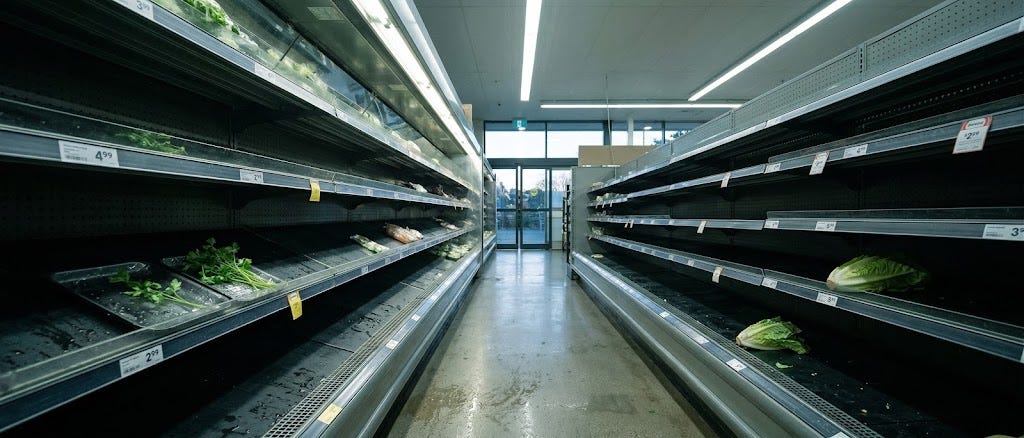
Iran is blockading the Strait of Hormuz. Urea exports out of the Persian Gulf are non-existent. Sulfur - the unglamorous backbone of phosphate fertilizer production - is just… sitting there. Planting season is closing fast. The global nitrogen supply chain, already under strain since Russia’s 2022 export restrictions, is looking at yet another shock. And China halted key fertilizer exports until at least August.
I know, I know. This sounds like the opening of yet another doom piece. But bear with me.
The reason I bring this up isn’t to scare you into stockpiling tinned beans in a bunker. Although at this point in time: why not?
It’s actually much simpler than that: food prices are going to go up. They’re going to go up whether the war stops today or drags on into autumn.
The fertilizer disruption I mentioned in previous articles (most recently here) won’t hit your supermarket shelf tomorrow. It’s lagged, so somewhere in the next 6 to 18 months, that’s when it’ll hit. Because THIS season’s harvest will THEN come up short. Or the next one. This lag is long enough that most people won’t connect the dots. They’ll just notice that tomatoes cost twice what they did.
You can either watch that happen, or you can do something about it.
A quick note before we dive in: I live in a temperate climate. The planting calendar, the prices, the climate assumptions - they all reflect that. If you’re in the US, the growing principles are identical but your specific frost dates and planting windows will differ. The USDA hardiness zone finder (link) is your friend. Prices are in euros throughout - swap the symbol for dollars and you’re close enough.
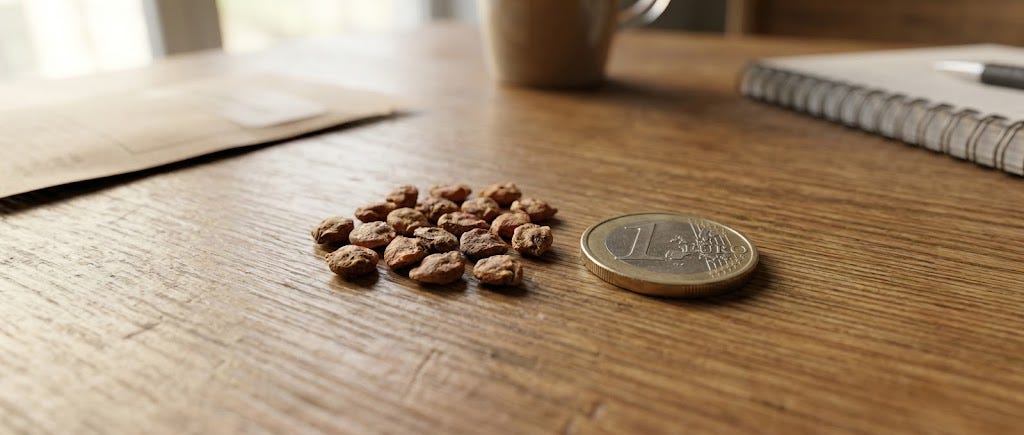
Let’s first talk about the economics, because yep, I’m a numbers guy first. So, what would it actually cost? TL;DR: it’s a better RoI than (stock) markets or saving accounts.
You can buy a packet of tomato seeds for €2-3, which contains 20-30 seeds. Six to eight of those will become plants. Each plant, in a reasonable season, produces around 2-4kg of fruit (yes yes, tomatoes are fruit!) - potentially 20-25kg of tomatoes from a single €3 packet, against supermarket prices currently climbing past €3-4 per kilo for anything decent. Courgettes are almost embarrassingly productive. One plant gives you 20-30 fruits over the season, more than most people know what to do with (we’ll get to that). Beans, peas, salad leaves: the same story across the board.
The startup cost for a basic garden? A few seed packets, a bag of compost, some pots if you need them, which nets to around €30-50.
Now scale that up. The average adult consumes around 150kg of vegetables per year. A family of four thus needs roughly 600kg. Studies on intensive home growing consistently show that 50-100 square metres of well-managed ground can cover most of a single person’s vegetable needs for a year. Not calories - you can’t realistically grow your staple carbohydrates in a small plot, and I’m not suggesting you try. But vegetables and fruit? Very achievable. A 200 sqm plot managed with any seriousness puts a family of four close to vegetable self-sufficiency. The average household spends somewhere between €600-800 per year on fresh vegetables. A well-run kitchen garden at that scale produces most of it from a standing investment of a few hundred euros in tools and infrastructure, amortised over decades.
And if you’re in a country where food inflation is running at 8-12% annually and your savings account is earning nothing, a food garden is one of the better-returning “investments” you’ll make this year. And unlike most investments, it doesn’t require a brokerage account, a risk tolerance questionnaire, or trusting someone in a suit.
We’re at an inflection point right now, in early April, where the gap between “I should probably start a garden” and “I actually started a garden” either closes or stays open for (yet) another year. The soil is warming. The daylight hours are increasing. Most temperate climates sit in a planting window that opens now and closes in late May for most warm-season crops. Miss it and you’re looking at a reduced harvest, smaller yields, or a season written off entirely.
This isn’t complicated. People have been doing this for thousands of years with significantly worse tools.
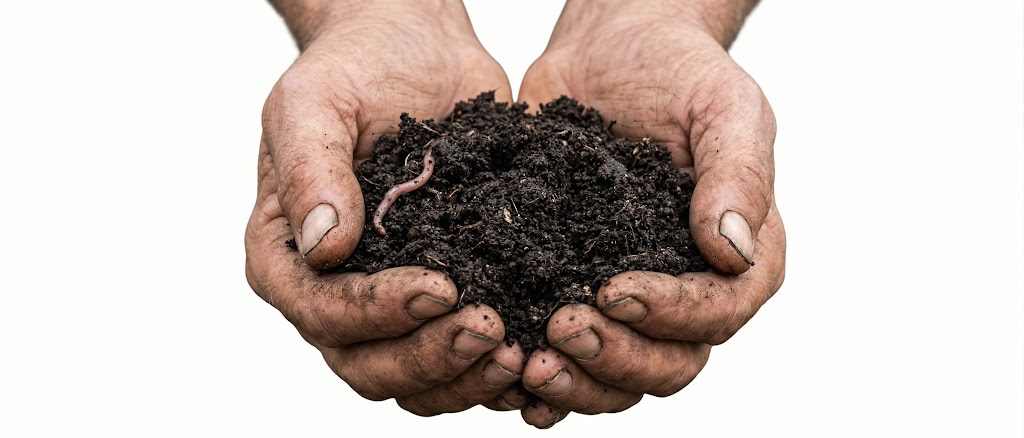
The most important thing to understand before you touch a single seed packet is that soil is everything. Not the container. Not the variety. Not the watering schedule. The soil. Living, biologically active soil. Full of fungal networks, bacteria, earthworms doing their unglamorous work. THAT is what determines whether you get a harvest or a sad stick in a pot. If you start with dead, compacted, nutrient-stripped growing medium and expect results, you’ll get exactly the garden you deserve.
So: buy good compost. Or better yet, make it yourself.
Composting is one of those things people overcomplicate until they give up. The reality is embarrassingly simple: pile up organic matter, wait, turn it occasionally, and in 3-6 months you have dark, crumbly, sweet-smelling material that will transform whatever you grow it in. Your kitchen scraps - vegetable peelings, coffee grounds, eggshells, tea bags - they all go in. Cardboard and paper (no glossy stuff) go in. Garden waste, dead leaves, grass clippings go in. What doesn’t go in: cooked food, meat, and dairy. Not because of some gardening law but because of rats. You don’t want rats.
The ratio that actually matters is carbon to nitrogen - roughly 3 parts “brown” stuff (cardboard, dried leaves, straw) to 1 part “green” stuff (fresh clippings, kitchen waste). Too much green and it becomes a slimy anaerobic swamp. Too much brown and nothing happens. The pile should feel like a wrung-out sponge: moist, not soaking. Turn it every couple of weeks if you want to accelerate it. Ignore it entirely if you don’t mind waiting longer.
You can start composting today, even in a flat, with a small lidded bin under the sink. The material you generate now will be ready for next spring.
Now. What to plant? And when?
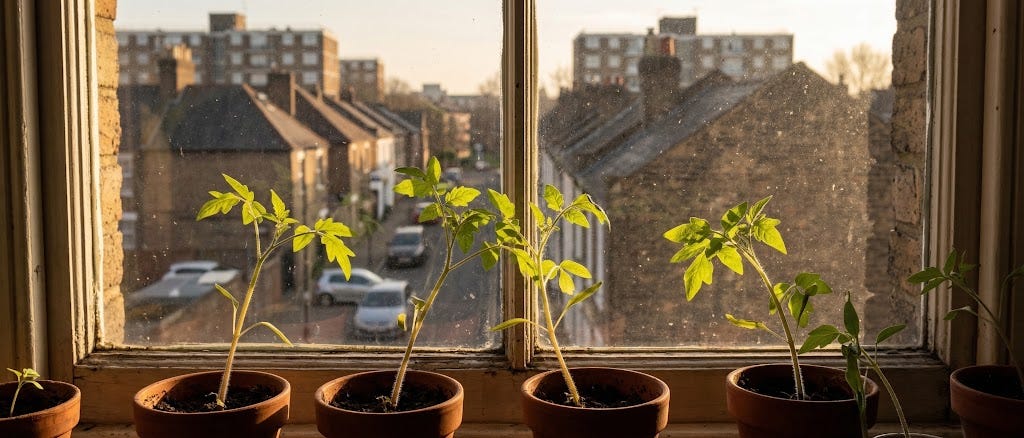
Indoors, right now: tomatoes, peppers, aubergines, courgettes, cucumbers, and anything from the cucurbit family needs 6-8 weeks of indoor growing before it goes outside. Start them on a south-facing windowsill in small pots or seed trays with decent seed compost. Keep them warm - above 18°C to germinate. A heated propagator is useful but not essential. A plastic bag over the pot does much the same job.
Direct into the ground (or into a container on your balcony), from mid-April onwards: lettuce, spinach, radishes, beetroot, spring onions, peas, broad beans, and carrots. These are cold-tolerant and will go in as soon as the last frost risk drops. In most temperate climates, that’s somewhere between mid-April and mid-May depending on your microclimate. Check your last frost date. Don’t assume - one late frost kills seedlings you spent six weeks nursing.
With salad crops especially, don’t sow everything at once. Stagger your sowings every 2-3 weeks and you get a continuous harvest through the season rather than a brief flood of lettuce followed by nothing. Succession planting sounds like some arcane technique for serious gardeners. It ain’t. It’s just common sense applied to biology.
Potatoes are a category unto themselves. They’re one of the highest-calorie outputs per square metre you can grow, incredibly forgiving, and deeply satisfying to harvest. Get seed potatoes now - they need chitting (sitting in a light, cool spot to sprout) for 4-6 weeks before planting. Even in a bucket on a balcony you can grow a decent yield.
Herbs are the fastest win and the most underrated. Basil (indoors only until June), chives, parsley, mint (keep it contained - it will colonise your entire garden given the chance), thyme, rosemary, and sage. These’ll all go from seed to useful in weeks. And they make everything you cook taste better.
The perennials are the long game worth starting this year: strawberries, rhubarb, asparagus. They won’t produce much the first season. By year two and three they repay the investment ten times over, and you do nothing except harvest.
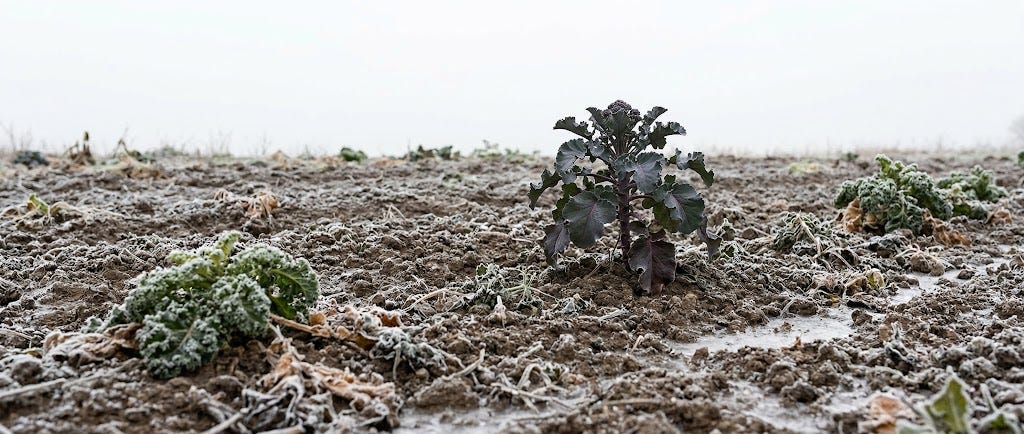
If you’re serious about year-round food production, you need to understand “the hungry gap”.
This is the period - roughly March through May - when last year’s stored crops are exhausted and this year’s haven’t yet produced anything worth harvesting. Historically it was the most dangerous time of year. It still is, in the sense that if you don’t plan specifically for it, you’ll discover in late March that your garden is an empty patch of mud while you wait six weeks for anything to appear.
The solution is deliberate. In autumn, plant garlic (goes in October, harvested the following July). Sow overwintering broad beans (they germinate before winter and sit dormant, then surge ahead of spring-sown varieties by weeks). Plant purple sprouting broccoli - it sits through winter as a small plant and delivers harvest from February through April exactly when you need it most. Leeks will stand in the ground through hard frost and can be pulled through winter and early spring. Kale, especially the hardier varieties, produces through everything.
Cover that gap and you have a genuinely year-round garden. The summer months will take care of themselves. January to May is where the planning needs to go.
Cold frames and cloches extend your season at both ends by 4-6 weeks without much cost or effort. A cold frame is just a bottomless box with a glass or polycarbonate lid - it traps warmth, protects from frost, and lets you start earlier in spring and continue later into autumn. Fleece over seedlings handles a light frost. A polytunnel - even a small one - effectively moves your climate one zone south and makes year-round salad production realistic in all but the coldest areas. If you have a polytunnel or a greenhouse, you can grow tomatoes in July that would never ripen reliably outside in an unreliable summers.
Winter crops for inside a cold frame or polytunnel: hardy salad leaves (claytonia, lamb’s lettuce, mizuna, mustard leaves), overwintering spinach, and cut-and-come-again Swiss chard. These grow slowly through winter but they grow, and they’re there when there’s nothing else.
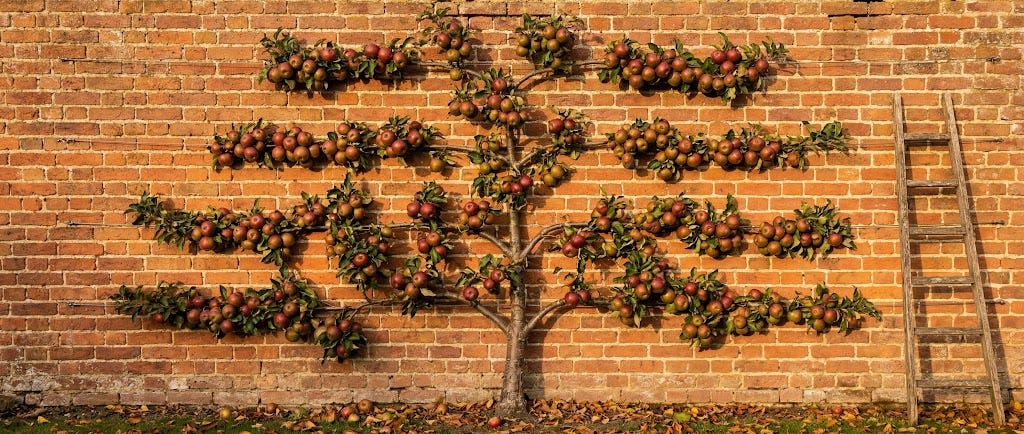
If you have more than 50 square metres of growing space, or you’re planning a longer-term setup: consider fruit trees and bushes.
Trees take 3-5 years to reach serious productivity but then produce for decades with minimal input. Apples are the workhorse of growing - enormous variety selection, reliable, and storable for months if you choose the right varieties. A dual harvest strategy (a July variety for fresh eating and a late October variety for storage) keeps you in fruit from summer through winter. Pears need a warmer spot, ideally against a south-facing wall. Plums are prolific in a good year and brutally generous - train yourself in jam-making before the plum tree matures. A morello cherry (the sour kind) tolerates shade, is self-fertile, and makes extraordinary preserves.
Dwarf rootstocks (M9 or M26 for apples) keep trees to 2-3 metres, manageable for a small garden, productive much earlier than standard trees, and suitable for training as espaliers - grown flat against a fence or wall, they take almost no lateral space, warm beautifully against brick, and yield surprisingly well. An espalier apple against a south-facing fence is one of the more elegant things you can do with an otherwise unused wall.
Fruit bushes are faster. Blackcurrants are the most productive per square metre of any common soft fruit - they’re also cold-hardy to a degree that is almost insulting to plants from warmer climates, and they contain more vitamin C by weight than citrus. Blueberries need acidic conditions (ericaceous compost, pH 4-5.5) and two different varieties to cross-pollinate, but once established they produce for 20+ years and the birds will fight you for the harvest. Get the netting ready first.
For raspberries: plant both summer-fruiting and autumn-fruiting varieties. They’re managed differently (summer canes fruit on year-old growth, autumn canes get cut to the ground in February and fruit on new growth), but the combination extends your raspberry season from June through October. A gooseberry bush tolerates more shade than almost anything else productive - that north-facing corner where nothing else thrives is a gooseberry’s natural habitat.
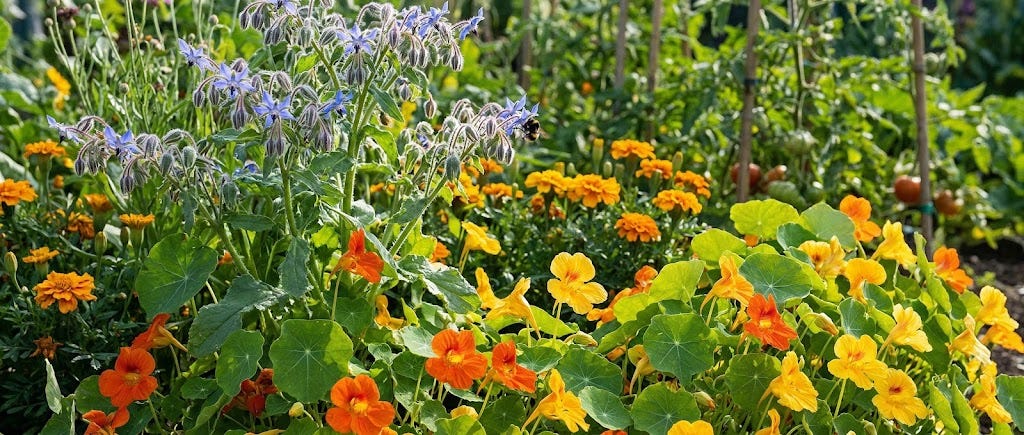
Something that I discovered through countless internet queries: companion planting.
It actually works! And the best companions do multiple jobs simultaneously. Nasturtiums are the most versatile: the flowers and leaves are edible (peppery, excellent in salads), the seeds can be pickled as ersatz capers, and the plant serves as a trap crop, drawing aphids and cabbage white butterflies away from the things you actually care about. They self-seed enthusiastically. Plant them once and you’ll never need to buy them again.
Borage grows tall, blue-starred, slightly hairy, and deeply beloved by bees. The flowers have a clean cucumber flavour and look extraordinary scattered over a salad. More importantly, borage alongside beans and courgettes dramatically increases pollination rates - you’ll notice it in your yields. It too self-seeds aggressively. Invite it once and it becomes a permanent resident.
Calendula (pot marigold, not French marigold) deserves a mention separate from companion planting. The petals are edible, with a mild saffron-adjacent flavour, and they colour rice and baked goods a warm yellow. The plant has anti-fungal properties that benefit neighbouring plants and it flowers for months in cheerful orange and yellow. It’s beautiful and useful, which is a rare combination.
Courgette flowers are one of the genuine luxuries of growing your own. The male flowers (the ones without a tiny courgette behind them) stuff beautifully - mix ricotta, lemon zest, and basil, seal the flower with a twist, and fry in light batter. This is food that never appears in supermarkets because it doesn’t travel. It exists only in gardens.
Chive flowers are edible and overlooked. The purple globes that appear in May and June taste of mild onion and add both flavour and something resembling elegance to anything they sit on.
There’s also a planting combination that’s been used for thousands of years and genuinely deserves its reputation: sweetcorn planted with climbing beans and squash. The corn provides a living pole for the beans to climb. The beans fix nitrogen that feeds the corn. The squash covers the ground beneath, suppressing weeds and retaining moisture. Each plant benefits the others. The system is closed enough that indigenous North American farmers sustained populations on it for centuries. It requires space (at least 3x3 metres for the corn to pollinate properly) but if you have it, the yields across all three crops are higher than growing them separately.
Comfrey is worth a dedicated mention. It’s not a food crop, though the young leaves are edible and have been eaten historically. What it does is accumulate nutrients: its roots go deep, pulling up minerals from layers of soil that most plants can’t reach. You cut the leaves and drop them around other plants as mulch, where they break down quickly and release those minerals. Or you stuff leaves into a bucket, fill it with water, weigh them down, and wait three weeks. The resulting liquid is a potent fertiliser that costs nothing. It also smells like something died in the bucket. Use it anyway.
Comfrey produces four or five cuts per season and regrows each time. Plant it in a corner you don’t mind being permanent - it doesn’t move once established.
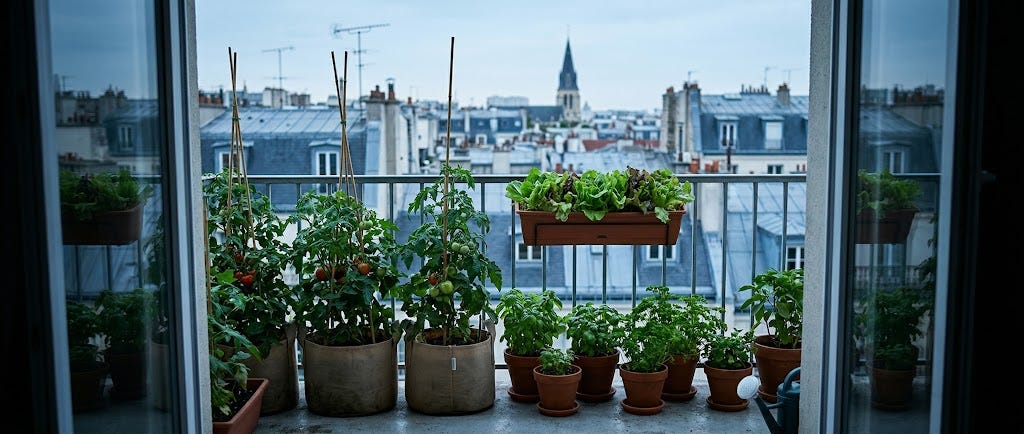
No garden? No problem.
I mean it. A balcony facing south or west, even 4 square metres of it, is genuinely productive space. Cherry tomatoes in 30-litre grow bags. Courgette plants (one is enough - one is actually too much, they produce aggressively). Salad leaves in window boxes. Strawberries in hanging baskets. A collection of herb pots by the door.
The one thing balcony growers generally underestimate is watering. Containers dry out fast, especially in summer, even more in terracotta. Get a big water reservoir if you can, or set up a simple drip system with a timer. Missing two days of watering in a July heatwave can kill a tomato plant that took eight weeks to grow.
Weight is also worth thinking about if you’re several floors up. Water is heavy. Saturated compost is heavy. Stick to lightweight plastic containers and peat-free compost that doesn’t turn into concrete when it dries.
Even a windowsill works. Herbs, microgreens, and sprouts require no outdoor space at all. Sprouts - lentils, chickpeas, fenugreek - are ready in 3-5 days, require nothing but a jar and a rubber band, and are nutritionally dense. This ain’t farming, but it’s a start.
A few other things worth knowing before you begin.
Water early in the morning, not in the middle of the day. Water goes where you want it - to the roots - not on the leaves. If you water in the evening, it will keep the soil wet overnight, which does invite fungal disease. So: morning it is.
Whilst on the topic of water: put a butt under your downpipe. A basic 200-litre rainwater collector costs €30-50 and fills up after a single decent rain. Tap water is also a supply chain. Even though it’s increasingly expensive. In a dry July, your water butt will be the difference between a living garden and a dead one, and you’ll have paid nothing for what it holds.
Mulch everything. A layer of straw, wood chip, or even torn-up cardboard around your plants keeps moisture in, suppresses weeds, and as it breaks down, feeds the soil. It’s one of those interventions that costs almost nothing and pays back constantly.
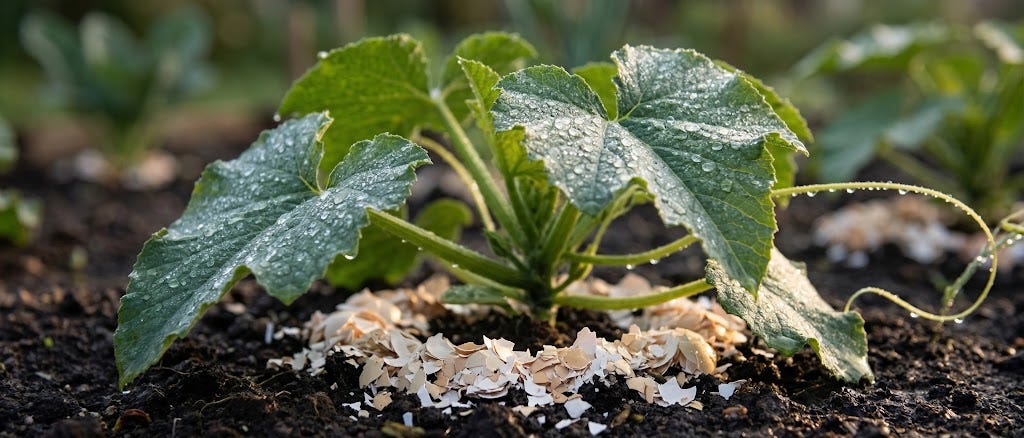
Then there are slugs. Nobody warns beginners about slugs, and then beginners go outside on the third morning to find their seedlings reduced to stumps. Slugs operate at night, in wet weather, with zero remorse. Copper tape around containers creates a barrier they won’t cross. Crushed eggshells around the base of plants help. Nematodes - microscopic parasites you water into the soil - are the nuclear option, effective and entirely organic. Check under boards and pots during the day and dispose of what you find. If you go out with a torch after rain, you’ll understand the scale of the problem.
You’ve been warned.
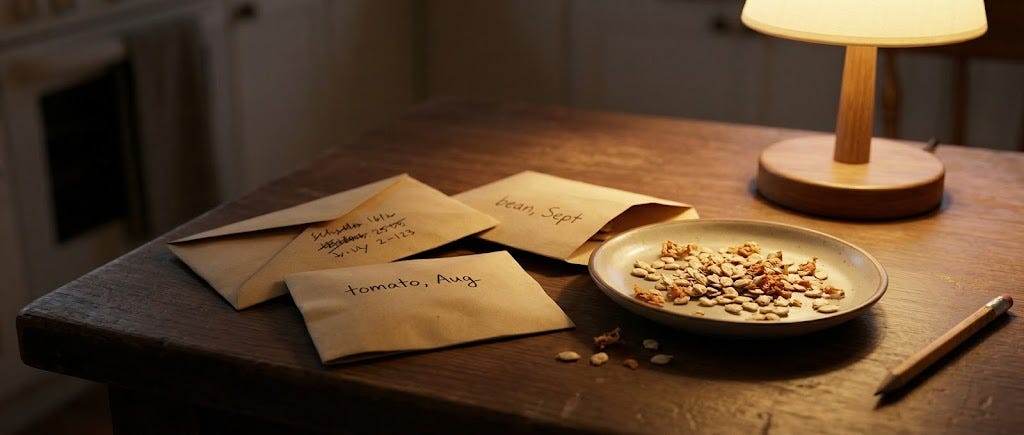
Save seeds! At the end of the season, let a few of your best tomatoes, courgettes, and beans go fully ripe - past the point you’d eat them - and collect the seeds. Dry them, store them in paper envelopes in a cool dark place. Next year you‘ll spend nothing on seeds.
If you’re buying seeds now, buy open-pollinated or heirloom varieties rather than F1 hybrids. F1 seeds don’t reliably reproduce true to type - the parent plant was created by crossing two lines, and the seeds from your harvest revert to unpredictable results.
Then there are GMO seeds. Those are genetically modified at the DNA level and almost universally patented - Bayer (which absorbed Monsanto) spent decades engineering seeds that don’t reproduce, not because sterility benefits the plant in any way, but because it converts a one-time purchase into a recurring subscription. Farmers in the US have been sued for saving seed from their own harvests. The business model is to make food production dependent on a single company. And it has worked spectacularly. Industrial agriculture is now structurally incapable of feeding itself without buying inputs from the people who sold it the problem.
GMO seeds are essentially unavailable to home gardeners anyway - they’re an industrial tool - so this isn’t a practical warning so much as a rant for why “just save your seeds” is a mildly political act at this point.
Heirloom varieties have been here for generations. That’s the whole point of them.
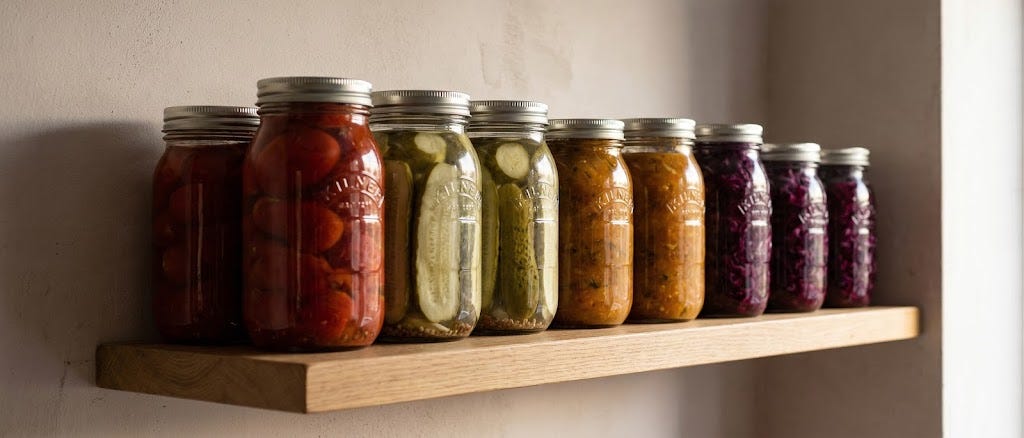
Now. About those 30 courgettes.
The garden will produce more than you can eat. That’s the point. But only if you know what to do with a glut when it arrives. Preservation is the other half of food security.
Lacto-fermentation is the easiest place to start and the most underrated skill in a home kitchen. No special equipment. No heat. You pack vegetables - cucumber, cabbage, green beans, almost anything - into a jar with salt water, weigh them down so they stay submerged, and leave them for a week. The naturally occurring bacteria do the rest. The result keeps for months in a cool place, is more nutritious than the raw vegetable, and tastes extraordinary. Kimchi and sauerkraut are the famous versions. The technique scales to almost everything you grow.
Pickling with vinegar is faster and simpler but kills the live cultures. Fine for storage, less interesting nutritionally. Drying works brilliantly for herbs, chillies, tomatoes, and beans - a cheap dehydrator or simply a warm spot out of direct sun does the job. Freezing is the blunt instrument: blanch most vegetables briefly in boiling water, cool them immediately, bag and freeze. It’s not elegant but it works and it requires no skill whatsoever.
The goal is to come out of summer with a pantry that looks different from how it looked in spring. That’s the actual buffer. Not a single season’s fresh harvest - that’s gone by October. The preserved surplus is what stretches through winter, and winter is when supply chains get interesting.
A food garden changes your relationship to the supply chain. Not by removing you from it. You’ll still shop… But you will have created a small, irreducible buffer that doesn’t depend on a ship clearing the Strait of Hormuz, a factory in Ukraine staying online, or a logistics hub in Rotterdam. YOU produced that. The fertilizer price spike didn’t touch it.
And something that’s even harder to quantify, something easier to dismiss. But I think it might actually be the most important thing.
The algorithm runs on urgency. Everything is breaking, escalating, collapsing, and everything is imminent. The algorithm rewards panic because panic keeps you scrolling, and scrolling keeps you clicking, and clicking keeps the machine fed. After a few years of this, a lot of people are walking around in a state of low-grade chronic dread they’ve stopped noticing because it’s become the baseline. That’s not a natural state. That’s an induced one.
A garden operates on a completely different clock. Seeds germinate when they’re ready. Soil builds over months and years. A fruit tree takes five seasons to hit its stride and doesn’t care what the Fed decided last Wednesday.
There is something genuinely disorienting about kneeling in the dirt with your hands in the soil and realising that the earthworm doing its work six inches down has been doing this, uninterrupted, for 200+ million years. Whatever is trending this week didn’t register then. It won’t register in six months either.
I’m not being romantic about it. I’m being precise. Research on what’s sometimes called “attention restoration theory” finds consistently that time spent in natural environments - even brief exposure to green space, soil, plants - measurably reduces cortisol levels, lowers heart rate, and restores the kind of diffuse, relaxed attention that screens actively degrade.
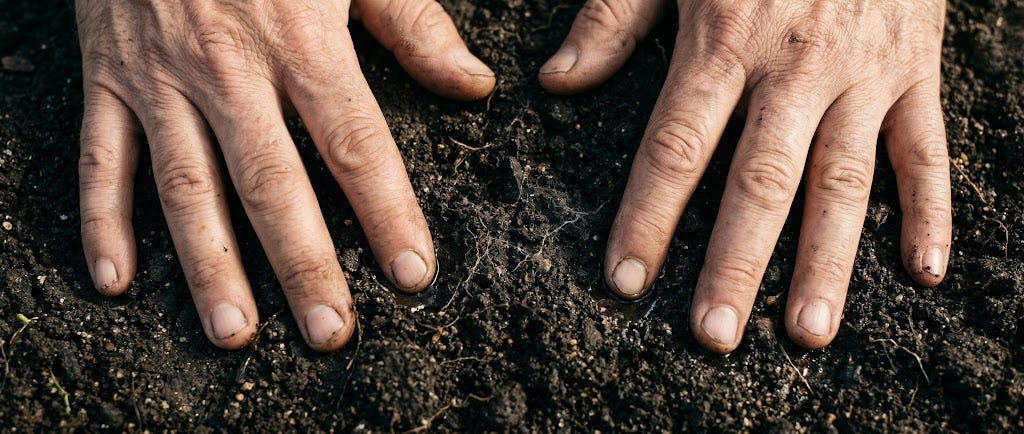
Getting your hands dirty is not a metaphor. The contact with soil microbiota has been linked to serotonin production - there’s a bacterium, Mycobacterium vaccae, found commonly in garden soil, that activates the same neural pathways as antidepressants. You’re literally touching something that makes you feel better, and the mechanism is biological, not psychological.
Furthermore, you can’t half-tend a garden. It requires you to be actually there. You notice the slug damage on the beans, the way the tomato has put out a new lateral that needs pinching, the first courgette hiding under a leaf you’d have missed if you hadn’t looked. This is not the fragmented, interrupted, notification-haunted attention that most of us spend our days in. It’s the other kind. The kind that comes back slowly, if you let it.
That’s not a trivial thing.
The last few years have been an extended lesson in how fragile complex systems get when the assumptions they’re built on stop holding. Energy. Supply chains. Currency. And now fertilizer.
The soil in your garden doesn’t care about any of that.
So “go touch grass”.
Well - I never knew that having my hands (no gloves) in the soil, gardening, made me happy because serotonin was produced!
Let me add one observation to this excellent essay on gardening: there's nothing in life like gardening, teaching one patience as well as flexibility - and there's nothing like gardening, eating the fruits of one's labour, which gives such contentment.
Let me finish with one of my favourite quotes, by the reformer Martin Luther who said: "Even if I knew that the world were to perish tomorrow - today I would still plant my little apple tree." Now go and get your hands dirty and plant one!
Great introductory writeup. Who know you had such depth and knowledge. Whole heartily agree with all of your advice. The best ROI is herbs as one uses a little at a time, they are expensive in the store, plus don't last long after you buy them. Further, they are always on hand, no need to run to the story, if they are out in the yard.
The one addition that I would add to your advice, is get some chickens. The young ones will lay almost an egg a day. A small flock can keep a family in eggs for most of the year. If you are not sentimental, they can end up in the stew pot once they stop laying and start to molt (Ours all have names, so they can't be eaten). Chickens are easy to care for, just provide food, water, some egg or oyster shells for supplemental calcium and importantly, a safe place to roost for the night. They are great for recycling food waste too. And what they don't eat like banana peels go into our worm bin.