
A simple question
But No1 knows the answer

I have been silent lately, because in my opinion there’s nothing to say. And when there’s nothing to say, one should stay silent.
If more politicians would follow that motto, the world’d be a better place…
War: groundhog day. US is licking its wounds, maybe preparing for “tha BIG one”. Iran counteracting, trolling even to dare USrael to attack.
PM: up, down, all around. Getting a bid lately which is nice. But I’m afraid the confidence ain’t there yet. Miners are holding up pretty decent. Which is what I would expect. [article has been queued, but I keep revising it to articulate properly the price of silver and the price of the miner. One day I’ll publish it…]
Oil: slowly upwards, managed destruction. Dunno. Feels weird. That’s another article I have had queued for about a month now. Situation didn’t change much though. Maybe for the worse.
Portfolio: no moves. I’m positioned. I’m waiting.

That said. I had an interesting talk the other day with my son about the rock that we all share. And from one came another and me being me… Yeah. Couldn’t hold myself.
Hold on to your coffee. This is going to get absurd.
A brief tour through several very confident, but mutually exclusive answers.
Humanity has spent thousands of years and a ridiculous amount of money trying to answer the one true question. No no, not the meaning to Life, the Universe and Everything.
We all know by now that that’s 43.
No no no… Today we’re going to talk about the rock under our feet.
And more precisely: what’s its shape?
You would think, by now, this would have been nailed down, right?
Well. It most certainly is not.
Ask five people and you get six entirely different physical objects, each one delivered as settled fact, defended with the total confidence of someone that knows absolutely nothing about the matter at hand.
So, to settle this debate once and for all, let’s go through them properly.
Bring a drink. Leave the bottle.
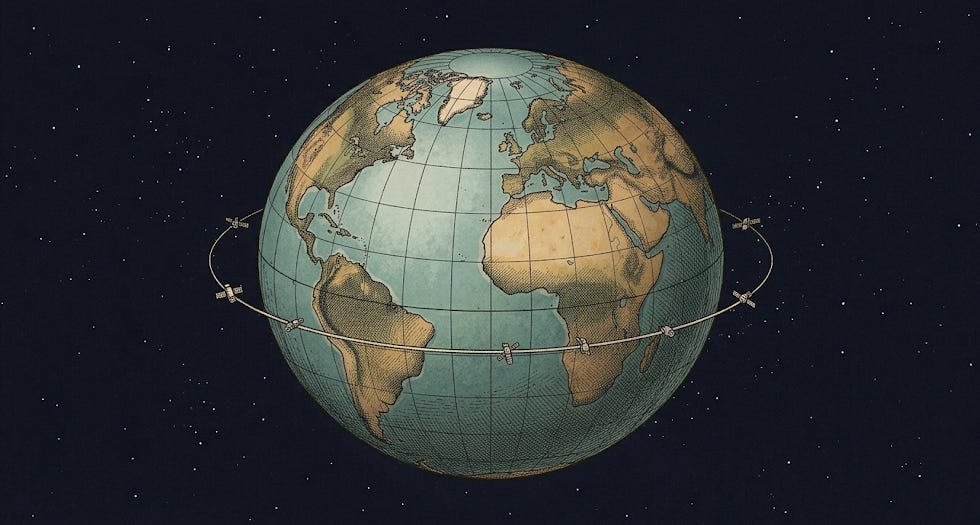
Let’s start with the mainstream position. At least for now.
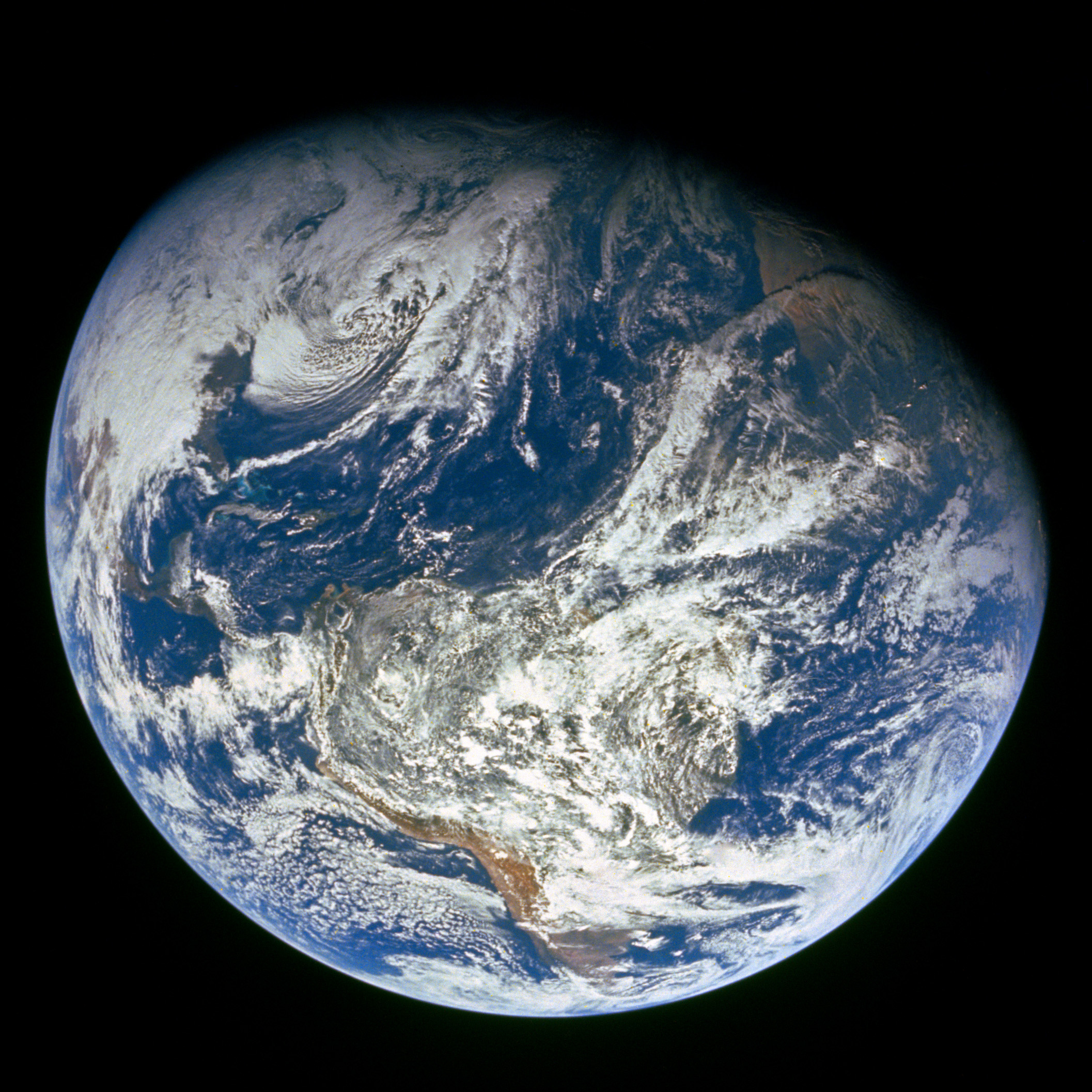
Earth is an oblate spheroid, a ball very slightly squashed at the poles by its own spin.
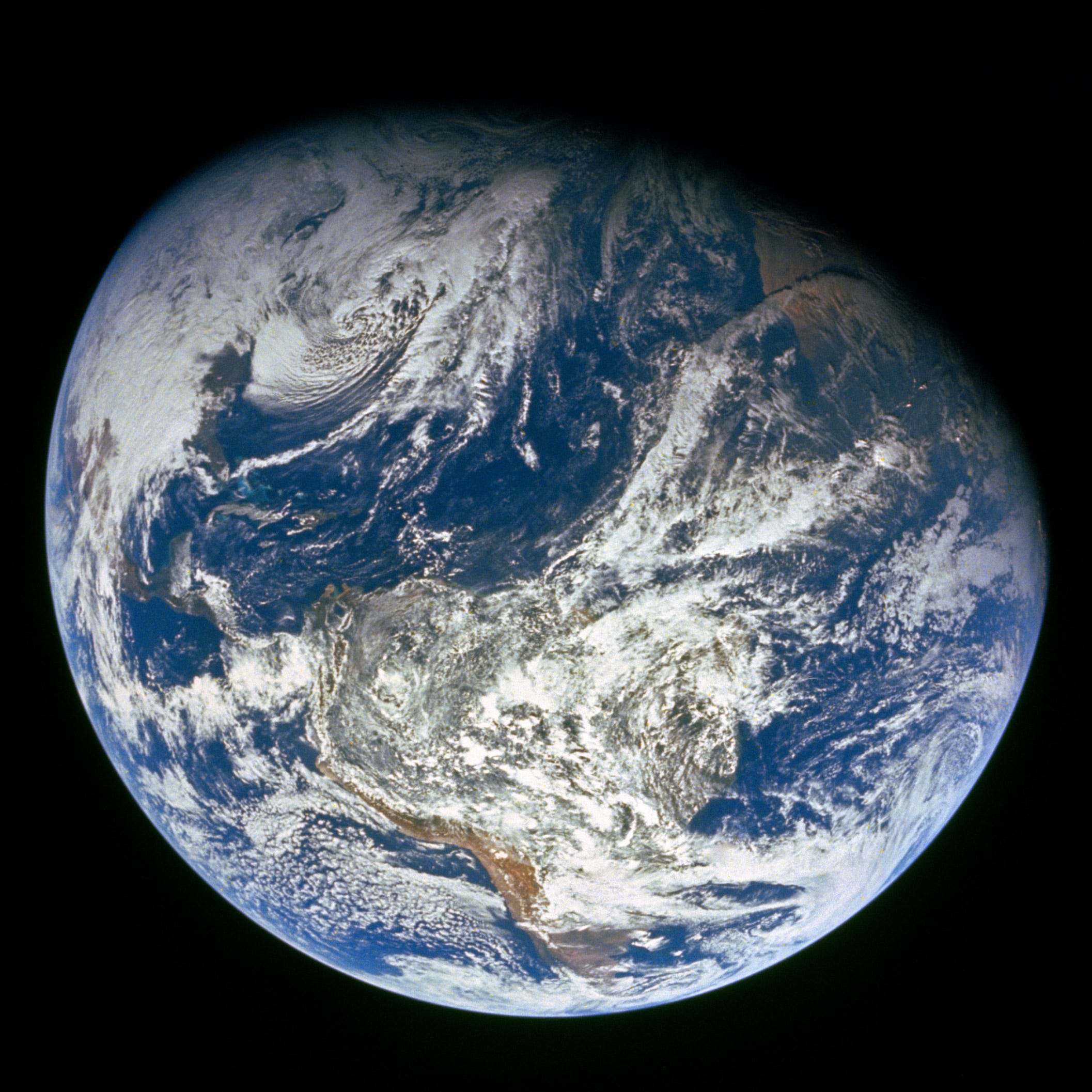
We have the photographs to prove it.
We have astronauts holding selfie sticks four hundred kilometres up.
Case closed. Or so you would think.
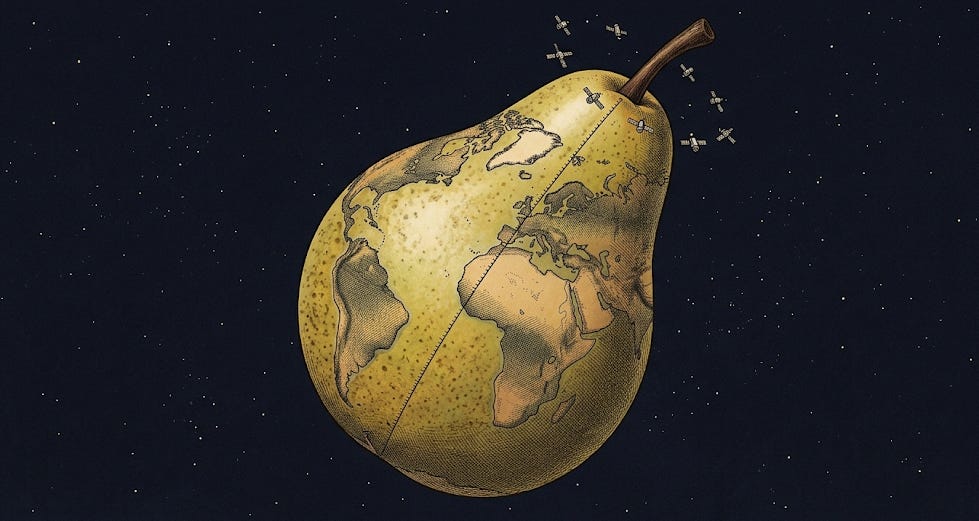
Except in 1958 a NASA scientist named John O’Keefe, no no, not the OMG one, pulled tracking data off the Vanguard 1 satellite and announced on the front page of actual newspapers that the ball wasn’t a ball.
Very slightly pear-shaped.
The North Pole stuck out a bit further than the maths expected.
The most rigorously measured planet in the solar system just turned into fruit.
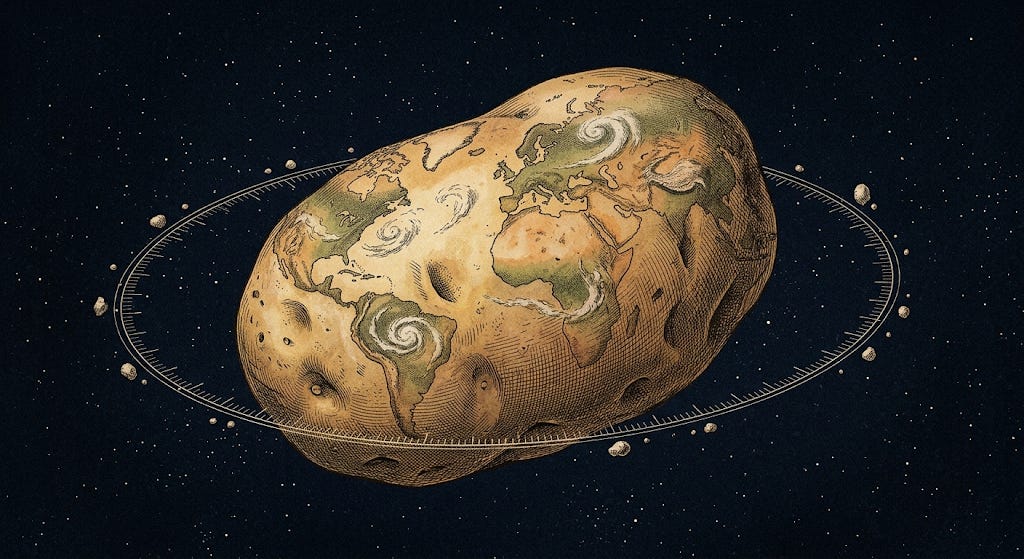
It got worse.
Sixty years and several better satellites later, the people whose entire job is to measure this thing released their highest-precision map yet and named it, officially, on the record, in scientific literature, the Potsdam Potato.
I wish I was making this up.
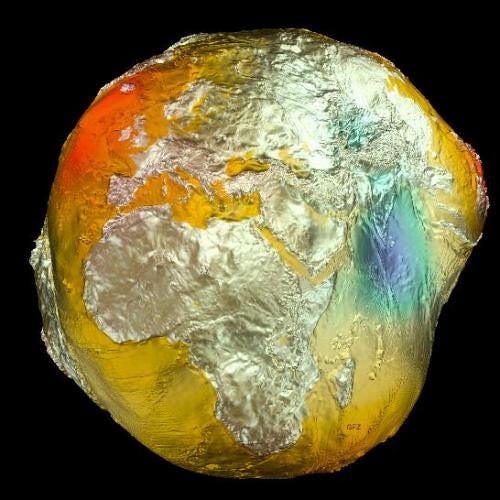
But it’s a real, published, institutional name.
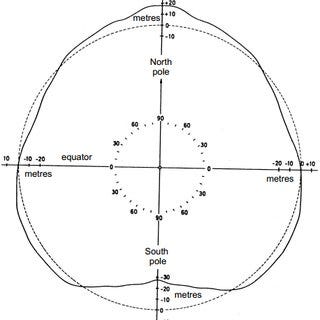
What almost No1 explains properly though, is that this potato isn’t the shape of the rock. It’s the geoid, a mathematical surface tracing everywhere gravity pulls with exactly equal strength, which happens to wobble by tens of metres because the planet’s mass isn’t evenly distributed underneath.
The picture is stretched ten thousand times for visibility so a human eye can even see it.
The actual solid body you’re standing on is an extremely boring, extremely well-measured oblate spheroid. Pole-to-pole, there’s a flattening by about twenty-one kilometres.
Eratosthenes worked that out already in Egypt around 240 BC.
He got within a few percent of the modern figure using a stick, a well and the angle of a shadow at noon. We’ve been getting dumber ever since.
Which makes the potato mash entirely self-inflicted. Scientists published a genuinely interesting gravity map. Unfortunately (or fortunately for the internet) they gave it a genuinely great name to make fun of. So the internet does what the internet does and concluded, based purely on the name, that No1 knows what they’re doing. I think they do, but don’t act surprised when you hand conspiracy theorists something from aisle 5 and expect them to NOT run with it…
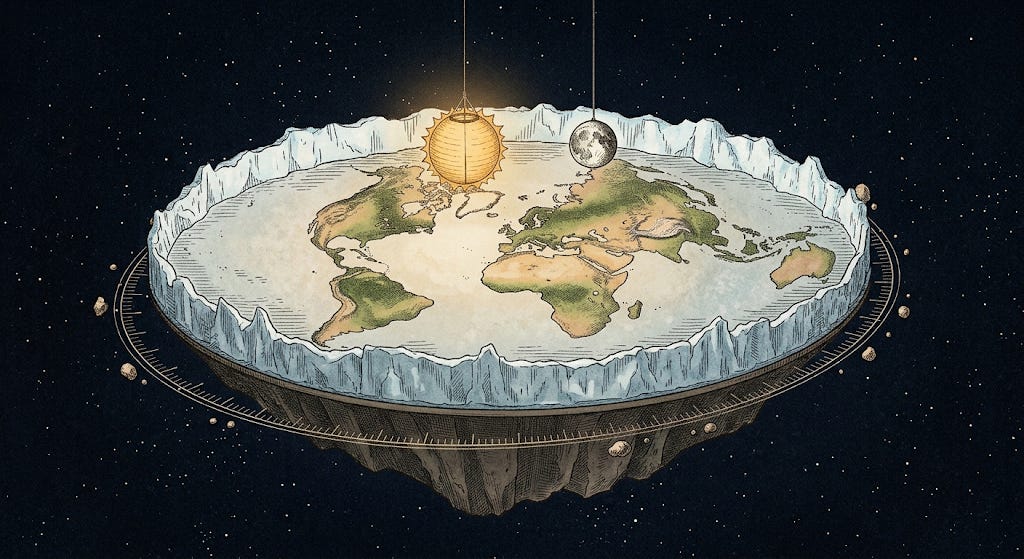
Speaking of conspiracies… The flat earth camp has been remarkably consistent. Which is either a warning sign they’re onto something or an impressive display of stamina.
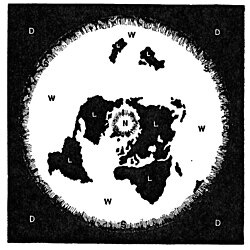
Samuel Rowbotham laid out the basic architecture in the 1800s. It features a flat disc, the North Pole in the centre, and an ice wall around the rim keeping the oceans from dribbling off the edge. At least he got that right.
His proof was the Bedford Level Experiment. Six miles of dead-straight English canal, no curvature visible along the surface with the naked eye.
But for this theory to be actually true, gravity as we currently understand it, cannot exist.
You’d need this disc to accelerate upward at a steady 9.8 metres per second squared. Forever. Where does the energy comes from? We would either be pushed, or pulled. What force could push/pull us toward the centre, perfectly imitate gravity in every way. But without being actual gravity?
Solve that and you’ve got a feasible theory.
The original proof didn’t even survive contact with a second experimenter.
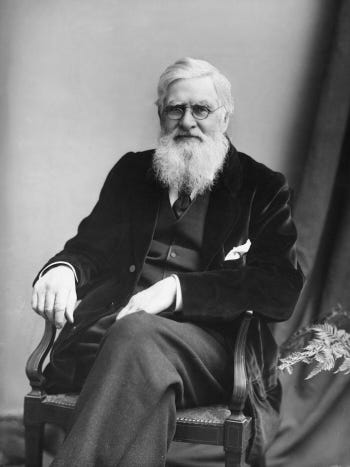
In 1870 the naturalist (not to be mistaken for naturist) Alfred Russel Wallace took a bet on it, redid the Bedford Level measurement properly, and found the curvature had been there the entire time. It’s just a peculiarity of how light bends slightly as it travels close to water.
Anyway in 1956, the whole operation got revived by Samuel Shenton, which is how we got the modern Flat Earth Society.
One year later, Sputnik went up.
Undaunted by any shred of proof, they’re still going strong, now run out of California by a man called Daniel Shenton (as far as anyone can tell there’s no relation to Samuel - which is its own small mystery).
Modern circumnavigation doesn’t help their case either.
Flights now cross Antarctica in times that only make sense on a globe, or a pear, or a potato. And thousands of unaffiliated amateur satellite spotters worldwide would need to be lying in perfect, uncoordinated unison for the ice-wall model to survive.
Their strongest argument is that you personally have never verified planetary curvature with your own eyes.
True.
I’ve also never personally verified that my kidneys are the correct shape.
I’m choosing to trust professionals on both counts. Which is kind of problematic when those same professionals keep changing their minds about produce.
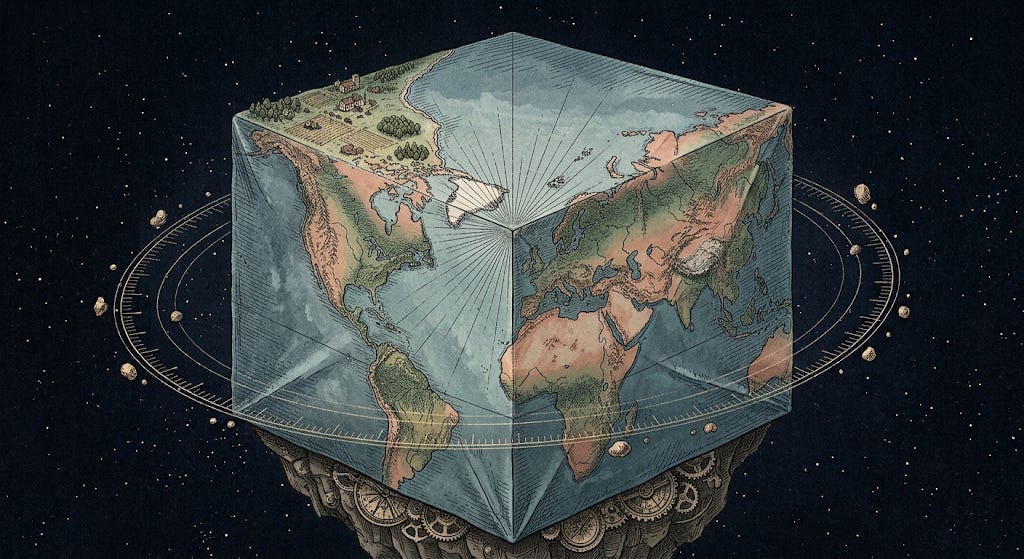
Then there’s Cube Earth…
Its sole reason of existence if because someone decided that a flat earth wasn’t ridiculous enough and needed a square.
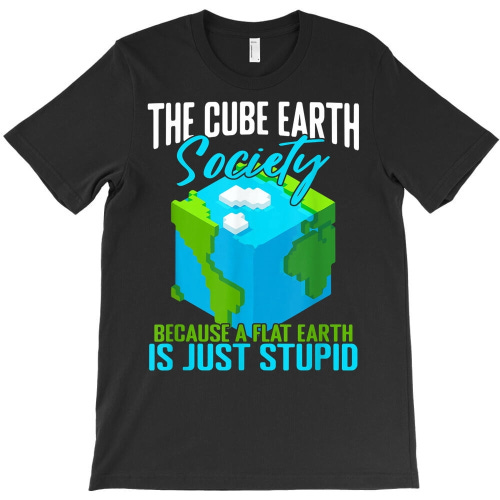
It all started as a parody account. They even got their own flag, flawless logic, t-shirts… Marketing wise they’re top notch!
But that’s not even the funniest fact about Cube Earth... Those people running the joke noticed their followers weren’t laughing.
They were measuring faces.
But let’s say we want to believe… What would a genuine cube-shaped planet need to do to actually survive? Because once a rocky body gets much larger than a few hundred kilometres across, its own gravity starts pulling it toward a sphere, corners first, because a corner has more mass bulging outward than a flat face does, and that extra pull drags material inward until everything’s roughly equidistant from the centre.
It’s the same reason large asteroids are round and small ones look like potatoes, sorry, that word again.
Secondly, anyone standing near an edge in the meantime would feel gravity pulling diagonally, like the ground was tilting the closer they got to a corner.
I haven’t seen any reports of an anomaly like that before…
But there are sincere believers of this theory.
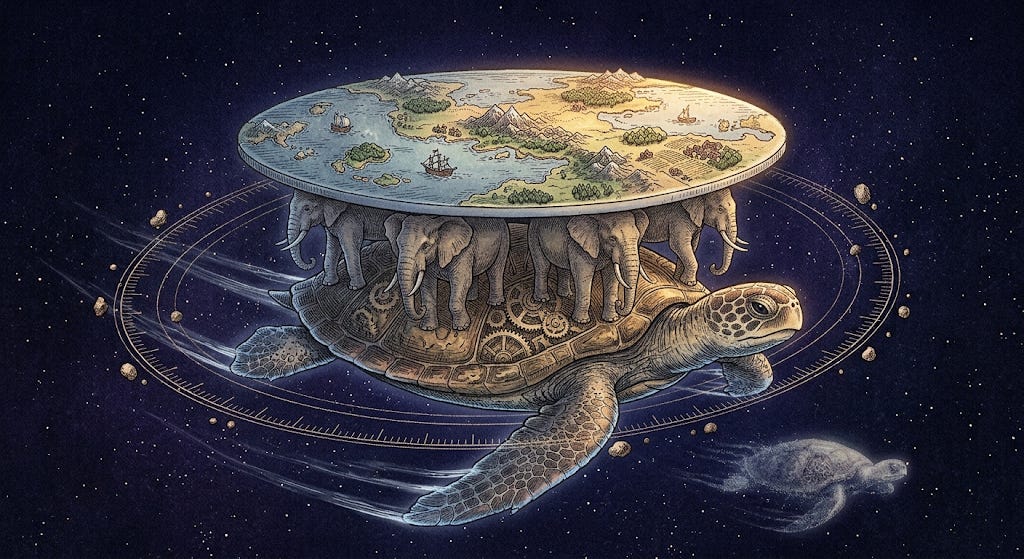
Hindu cosmological tradition offers the world resting on the backs of four elephants, who stand on the shell of a colossal turtle named Akupara.
Just one eeny teeny tiny small structural problem that nobody, in several thousand years, has managed to patch.
What is the turtle standing on?
The honest answer seems to be another turtle. And under that one, going by the framework, another one. It’s turtles all the way down, which in my opinion is a very polite way of saying nobody knows.
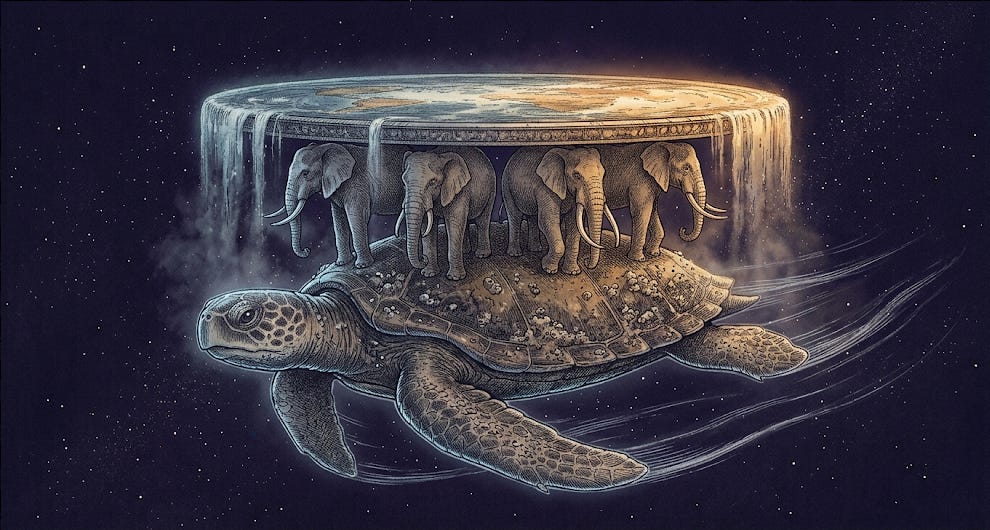
Terry Pratchett solved this the way only Terry Pratchett can.
Discworld sits on four elephants, Berilia, Tubul, Great T’Phon and Jerakeen, standing on the shell of Great A’Tuin, a star turtle of the species Chelys galactica, and that’s where it stops.
One turtle.
Swimming through ordinary space toward an unknown destination, no further turtles required underneath.
Disc astronomers reportedly spent generations trying to work out A’Tuin’s sex, since the entire fate of the Disc’s mating-flight cosmology hinged on it, and at one point sent an expedition off the edge to go and check directly. It did not come back with an answer.
There’s also a minor legend on the Disc that there used to be a fifth elephant, until it lost its footing and came down through the sky to form an entire mountain range on impact. Either that’s a cool myth about geology, or on of the best excuses I’ve heard for a workplace accident.
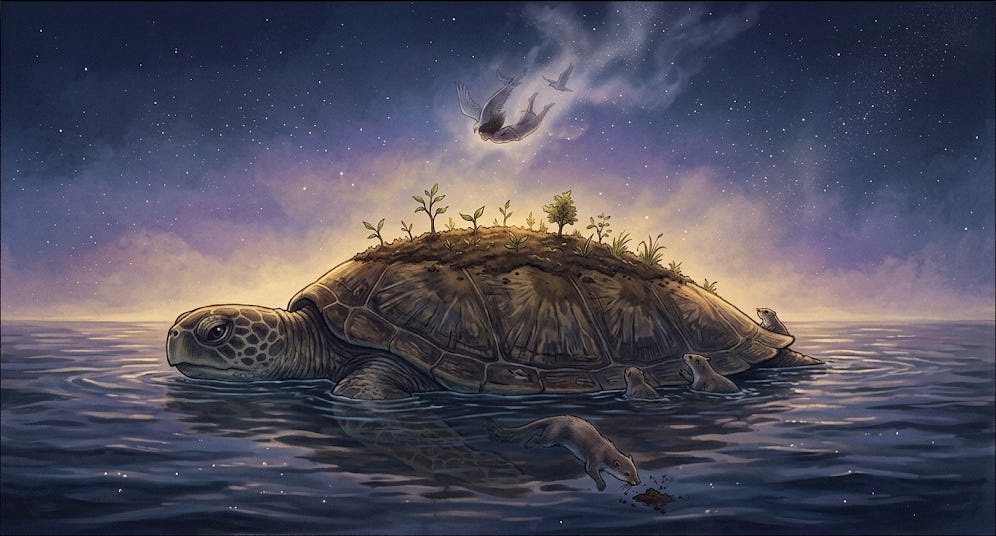
Long before Pratchett and the Hindus, several Indigenous nations of North America, the Haudenosaunee and Lenape among them, tell creation stories in which the continent itself grew on the back of a turtle, giving rise to the name still used today: Turtle Island.
Three unconnected traditions, on three different continents, all reaching independently for the same animal to hold everything up.
I guess turtles are cosmically significant.
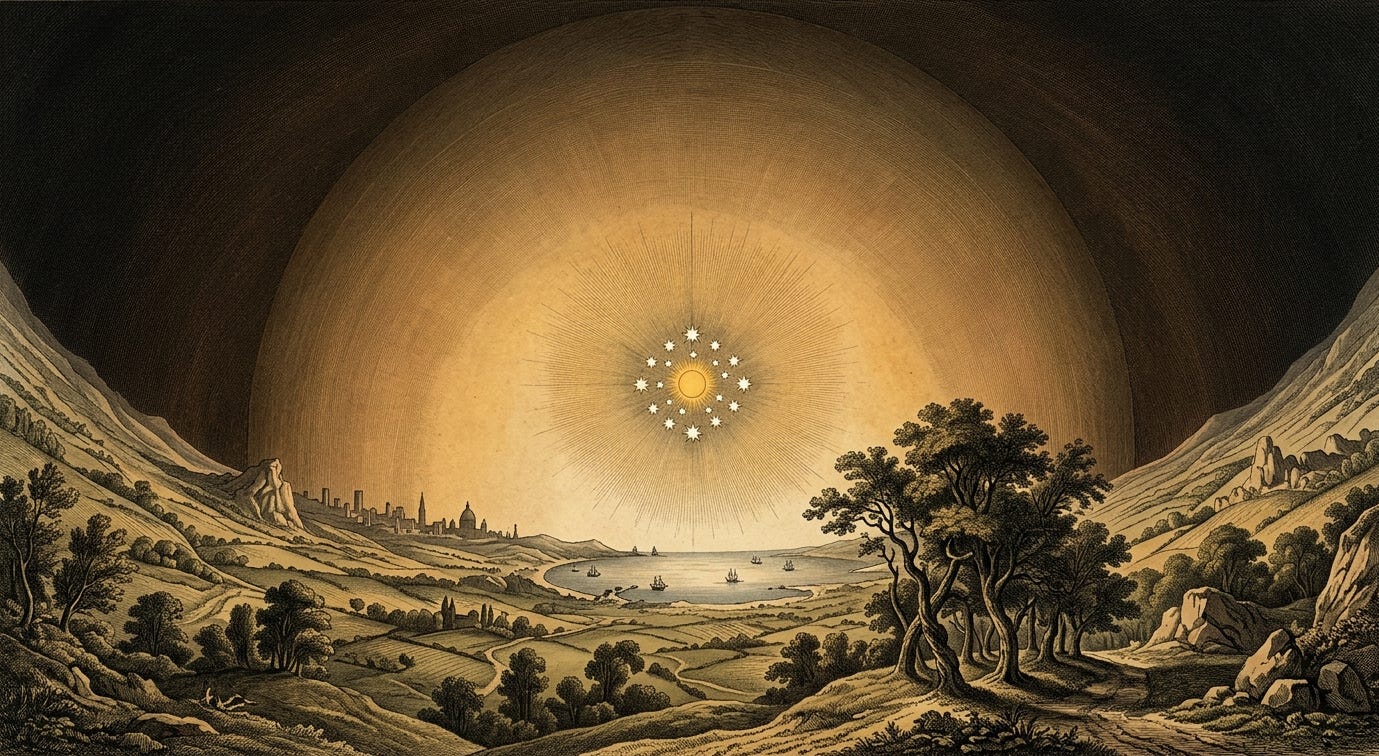
And then, because turtles, elephants, a pear and a potato weren’t enough options on the table, a Florida sect in the 1890s proposed the opposite of everything above.
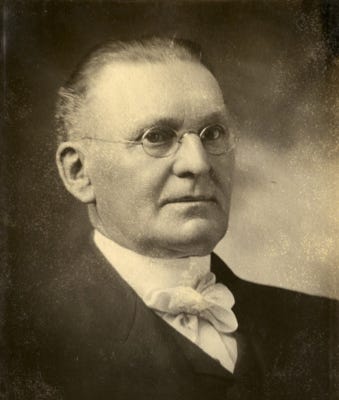
Cyrus Teed, a doctor turned self-declared messiah, tought that we don’t live on the surface of a sphere at all.
We live inside one.
The sun and the stars are sitting in the middle of a hollow shell eight thousand miles across, ground curving up and away from you instead of down.
The gravity is replaced by centrifugal force from the rotation.
But every space probe humanity has ever launched in any direction (like Voyager) would have had to physically strike the inner wall a few thousand miles up.
As far as I know, none of them did. So either his calculations are off-by-one or it’s yet another disproven not-yet-proven theory.
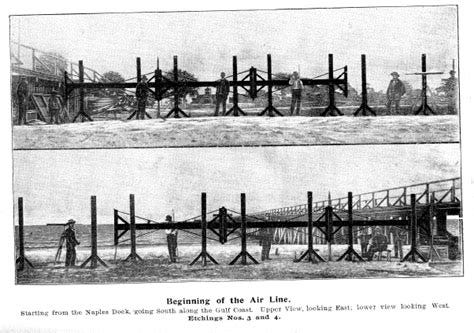
His followers built an actual scientific apparatus, called the rectilineator. It undoubtedly proved that the earth was curved the wrong way.
Notice that this group ran a multi-month field survey, and produced actual data supporting their theory.
So did the potato people… With considerably better funding.
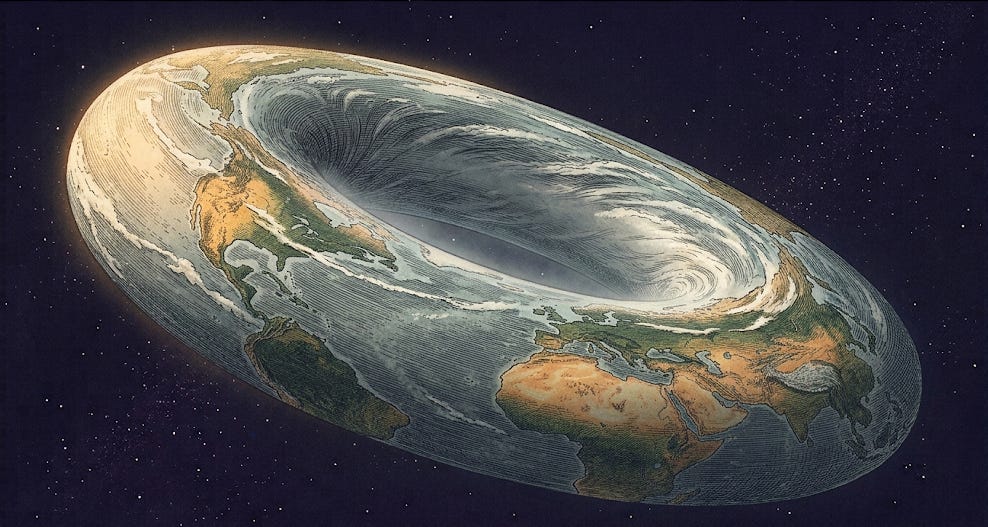
Then there’s the donut.
In 2012, a Flat Earth Society member proposed that the Earth is neither flat nor round but toroidal, a donut. What you need to believe is that the way light bends along the torus’s own curvature that it makes the hole invisible.
Gravity, in this framework, pulls toward the densest part of the ring, which Varaug explained with a metaphor involving a jam doughnut.
Gravity acts toward the jam. Great scientific explanation.
Actual physicists took it as a fun problem and did the math anyway. Real modelling of a torus-shaped planet shows gravity would be noticeably weaker at the inner and outer equators and stronger near the poles, a day-night cycle closer to three hours than twenty-four, and wind speeds strong enough to leave large parts of the ring uninhabitable.
The same modelling suggests however that the magnetic field lines on an actual toroidal planet wouldn’t intersect the surface the way you’d need for any aurora-like glow near the hole.
It also runs into the exact same problem cube earth did. A body with enough mass to hold an atmosphere wants to collapse toward a sphere under its own gravity, holes or corners be damned, so a torus this size would need to spin extremely fast just to hold its shape.
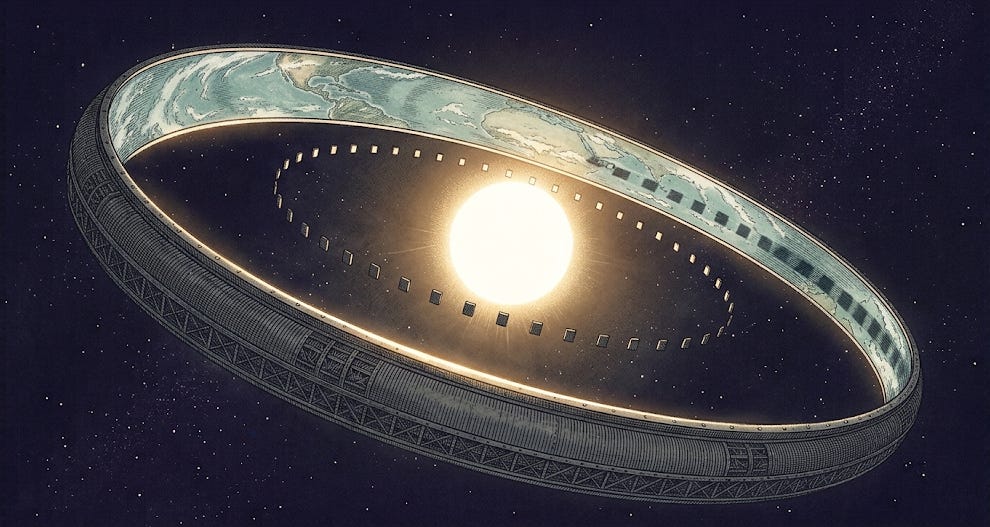
Larry Niven’s 1970 novel Ringworld imagines an artificial band roughly the diameter of Earth’s orbit, spinning fast enough around its star to fake gravity along the inner rim, with a chain of shadow squares orbiting closer in to fake a day-night cycle.
It picked up the Hugo, the Nebula and the Locus awards. Which is more than every other theory in this article has managed between them combined.
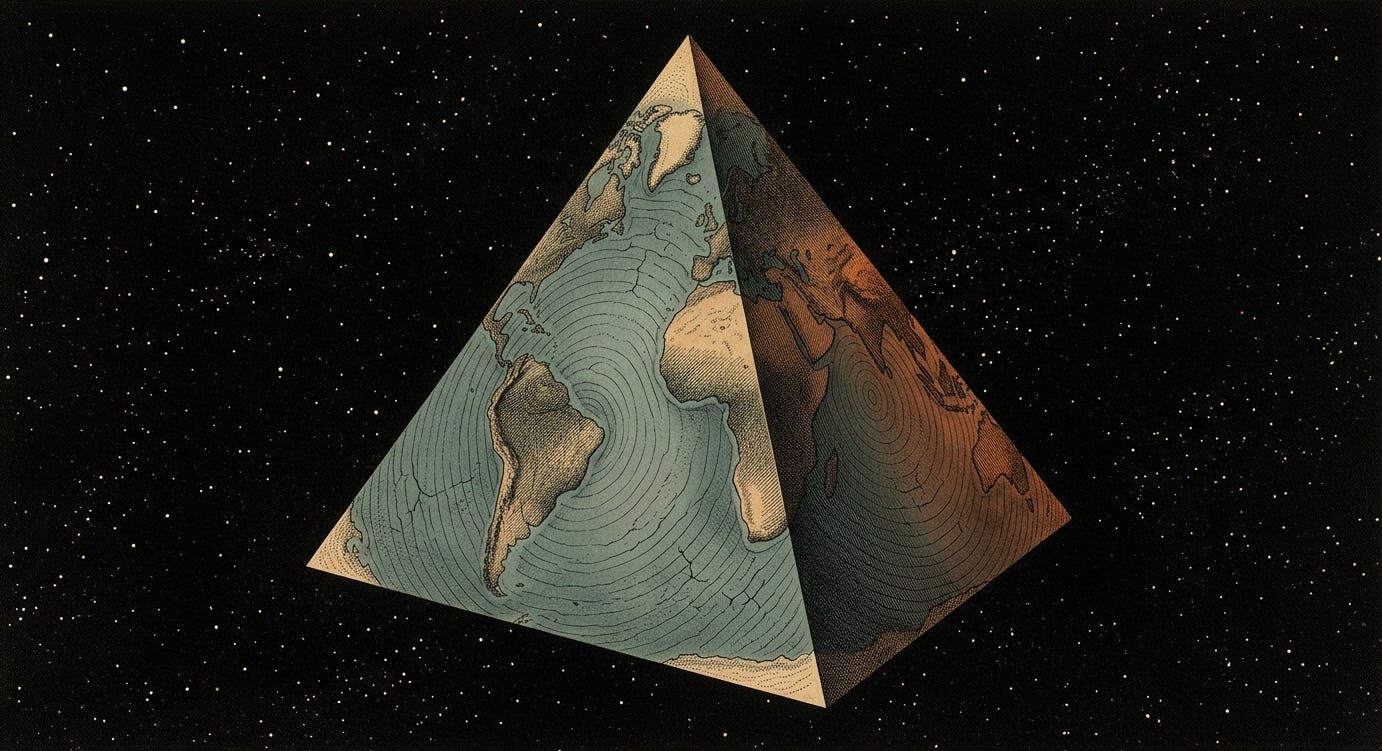
Nothing beats the tetrahedron though. Proposed in 1875 by a Hawaiian cabinet minister named William Lowthian Green. He argued that a cooling, contracting sphere would naturally settle into the shape with the least volume for its surface area.
Which happens to be a pyramid.
Land at the four corners, ocean in between.
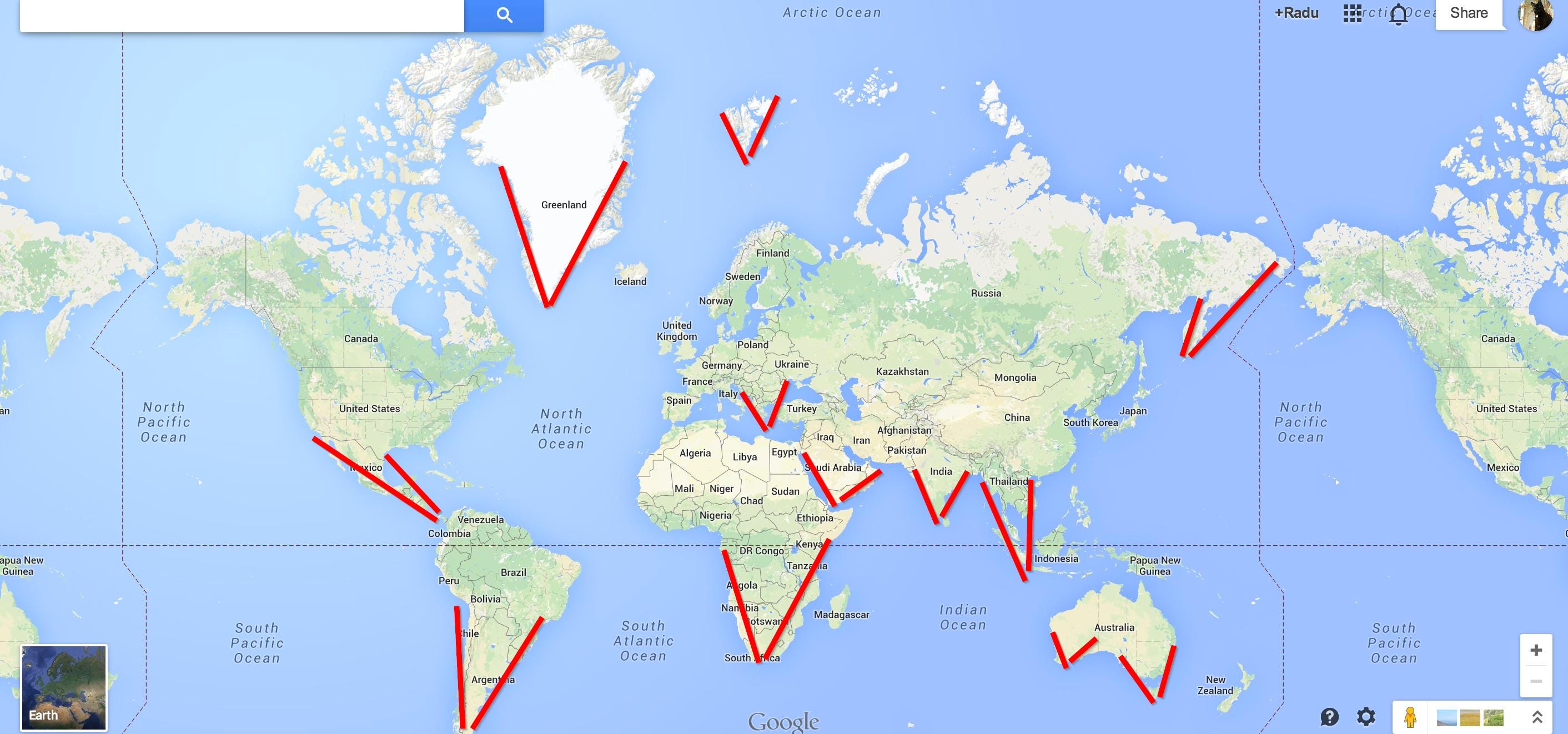
He DOES have a point though. Because continents genuinely do taper toward the south in a rough triangular pattern, if you squint hard enough that is.
That coincidence is exactly why serious geologists took the idea seriously for decades.
It got published and taught as a live hypothesis as recent as 1917.
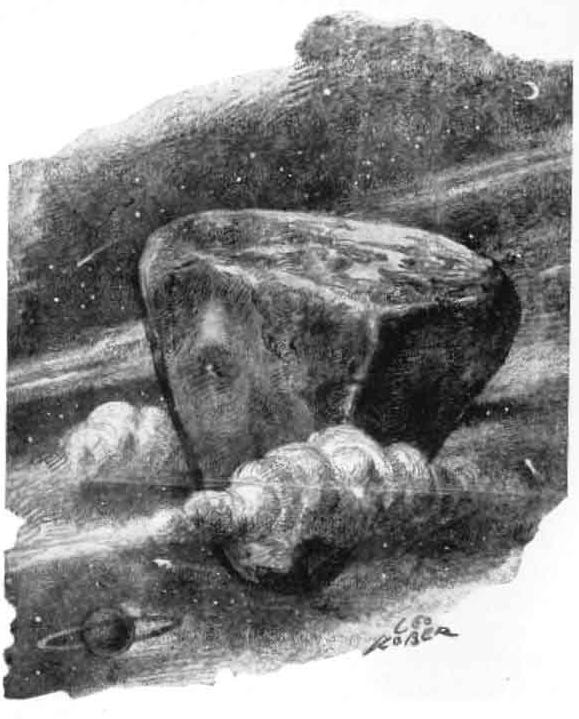

The Illustrated London News printed it in 1926 with a full illustration of a tetrahedral Earth, presented as simply one of the live options, alongside ball and, presumably, potato-in-waiting.
Two things quietly killed it.
First, the discovery of radioactivity in the early 1900s revealed that the planet’s interior keeps generating its own heat. Which meant that the whole premise of a passively cooling sphere was based on a faulty assumption.
And more decisively, seafloor surveys in the 1960s found symmetrical stripes of reversed magnetism running in matching bands on either side of the mid-ocean ridges.
Exactly what plate tectonics predicted and the tetrahedron never could.
My final say in this whole rabbit hole?
It’s a ball. Or a pear. Or a potato.
I don’t really care either way.
I didn’t venture into space and have a look what it truly is. Even if I would have cash to spare I wouldn’t. Because why would I?
I would still need to come down to this ball, or pear, or potato.
I would love to travel the stars like Ender and Jane.
But we’re stuck here.
On this ball.
Or pear.
Or potato.
My other publications:
[Daily Digest] → The news in 5 minutes, without the forty open tabs.
[Portfolio] → What I do with my own money
I'm too sober for this article, No. 1.
I enjoyed Larry Niven’s novel Ringworld, thanks for the reminder :-)