
The vertical phase
🚀🌜🚀

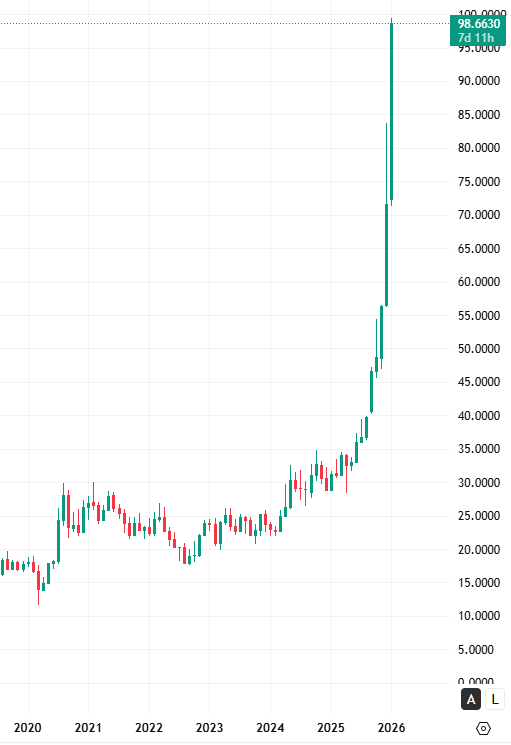
The global monetary system is fracturing along multiple fault lines simultaneously. And when those systems fail, they rarely fail slowly or from a single cause. They fail because pressure builds across a multitude of weak points until something snaps, and right now we’re watching pressure build everywhere all at once. Geopolitical trust is evaporating. Fiscal discipline is nonexistent. Supply chains are weaponizing. Currency debasement is accelerating. And capital is running toward assets without counterparty risk.
And yes, precious metals -with silver in particular- sit right at the exact intersection of all these forces.
Let’s start with trust, because that’s ultimately what fiat currencies depend on. The confiscation of Russian reserves in 2022 was the first serious crack - it established a precedent that Western assets could be seized for political reasons. (The withholding of the Venezuelan gold reserves was the first in my opinion). Central banks certainly noticed that move. They noticed that their “reserves” might not actually be reserves if Washington decides otherwise. Then Trump started threatening allies. Last year Europe over trade. Now Denmark over Greenland. Handing out tariffs on everyone like it’s candy at a Halloween fest. Or the DOJ that got subpoenaed. I mean, the Fed Chair got called up over a building renovation (yeah right). At this point, it doesn’t even matter if you think these moves are justified or strategic or whatever. What actually matters is how it looks to foreign investors and central banks holding trillions in dollar-denominated assets. They’re questioning whether the USA is a stable jurisdiction or yet another banana republic. Are those assets really mine? Or just temporarily permitted?
Germany is being urged to repatriate over $100 billion in gold from US vaults. That’s not some conspiracy theory fringe thinking. That’s mainstream German politics responding to a trust crisis. When your allies start pulling physical assets home because they’re worried about access, your trust (and thus your reserve currency system) has a MAJOR problem. Central banks globally are moving into gold, silver, just about ANY physical commodity because those have no counterparty risk. Nobody can decree that your gold bar ain’t yours anymore. Nobody can freeze your silver vault. Physical is the final settlement.
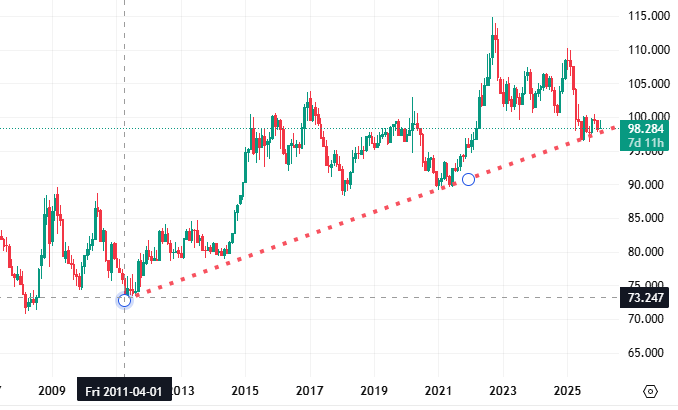
The dollar itself is breaking down technically. The DXY monthly chart shows 15-year support from the 2011 uptrend cracking under pressure after bleeding from 110 to 98 over the past year. As I see it, a potential break of the 15-year support is coming. This would have major macro implications. The graph just confirms my gut feeling about the macro-setup. But it’ll give the move extra impetus, because when the world’s reserve currency breaks this multi-decade technical support, everything priced in that currency reprices. (Just see what silver did after breaking a 45 year cup/handle support). This isn’t just about that chart pattern. More importantly, it’s what happens when the flows that supported the dollar reverse.
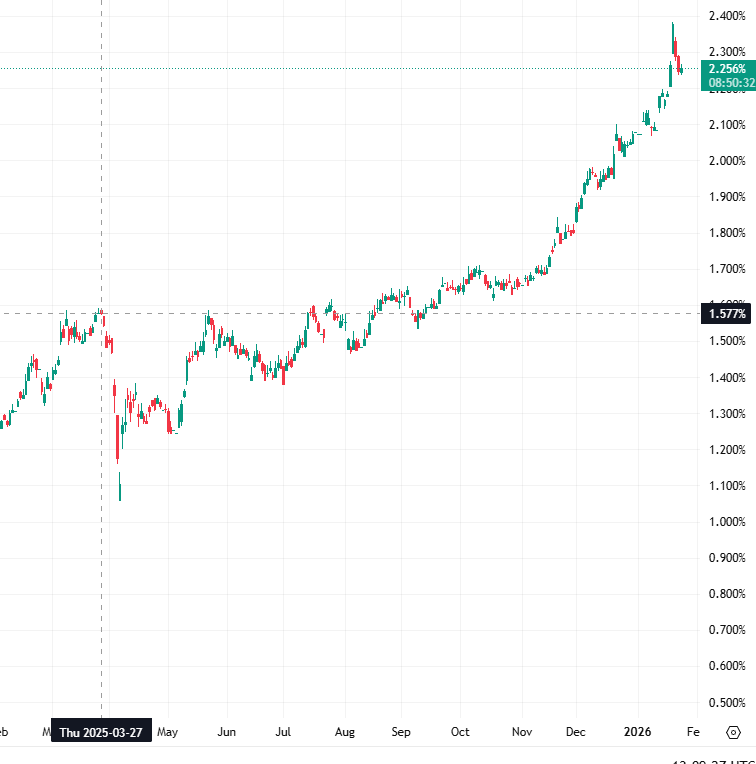
Japan’s bond market had a yield spike last year that triggered brutal selloffs in global markets. The markets recovered. We moved on. But each time this happens, it leaves a scar. Those add up in the end! However, yields didn’t stay down - they kept on climbing, and this week they literally exploded. The 40-year JGB hit 4.24%, the 30-year jumped 42 basis points in two days, the 10-year touched 2.38% for the first time since 1999. The cited reason? PM Takaichi pitched some massive stimulus spending and tax cuts to a country sitting on 256% debt-to-GDP with no explanation of how to fund it. Bond vigilantes who’ve been dead for decades rose from their graves and said no.
Why is this important in the context of the plumbing of the global markets? I’m glad you asked… It’s because Japanese institutions spent decades buying foreign assets (mainly bonds and stocks) because their own yields were pathetic. However, the current interest rates changed the calculation completely. Why would you buy USTs at 4.3% when JGBs now offer a similar yields without the currency risk? I’m guessing that the global bond selloff this week was Japanese capital repatriating. When Japanese money stops funding US deficits, who will fill that gap? The Fed already proved with QE that they can’t print their way out without creating inflation. Europe has its own sovereign debt crisis. China is hostile. The assumption that someone will always buy the debt is dying, and term premiums are repricing globally as markets absorb that governments can’t borrow infinitely without consequences.
Then there’s the supply chain dimension. China reclassified silver as a strategic material on January 1st and restricted exports. They’re doing the same across rare earths, antimony, gallium, germanium - slowly choking off supply to Western industries that never bothered developing alternatives because Chinese supply was cheap and reliable (see my upcoming article). Silver is now explicitly a weapon in the raging trade war. The years long deficit in silver wasn’t a problem when everyone assumed metal could move freely across borders. But now that China is restricting the flow and pulling physical at a premium into Shanghai, that deficit becomes acute.
You can’t paper over years of net consumption of physical.
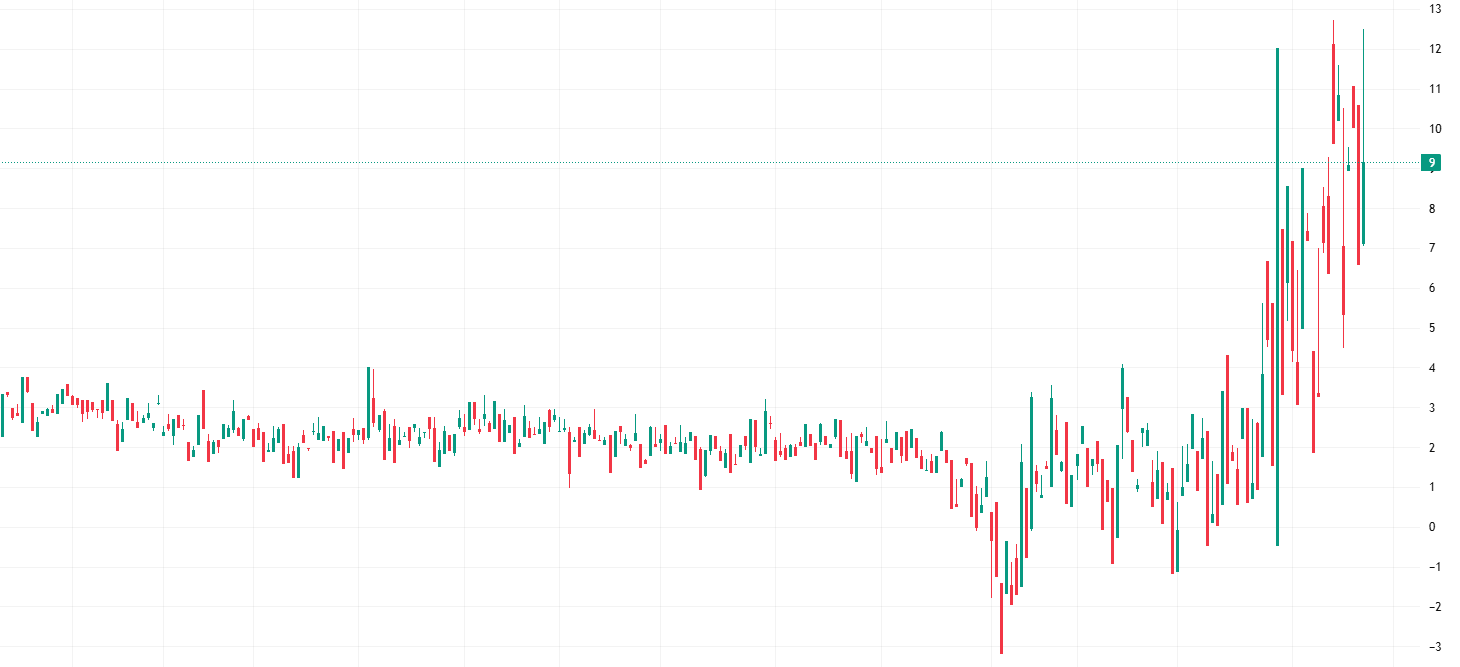
Shanghai’s physical silver is trading with a persistent $10-15 premium over COMEX, and that spread keeps widening. When you see that the physical markets in the East consistently pay 10-15% more than New York’s paper price, that’s not some arbitrage waiting to close. The market is screaming that paper and physical have decoupled fundamentally, and the East is pulling metal regardless of what games get played in the futures pits.
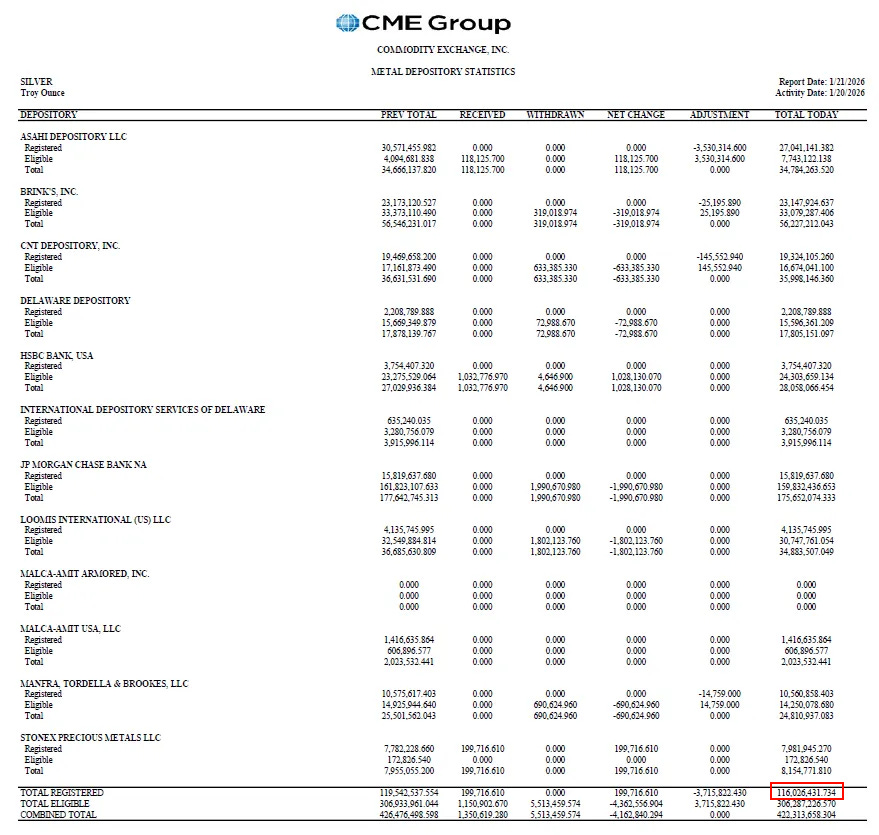
Which brings us to the COMEX (CRiMEX?), where the pressure points converge into something mechanical and potentially violent. The exchange’s own depository statistics show registered silver - metal available for delivery against futures contracts - around 114-120 million ounces. Open interest sits at 150,000 contracts representing 770 million ounces of paper exposure. The exchange has metal to cover maybe 15-16% of its paper claims.
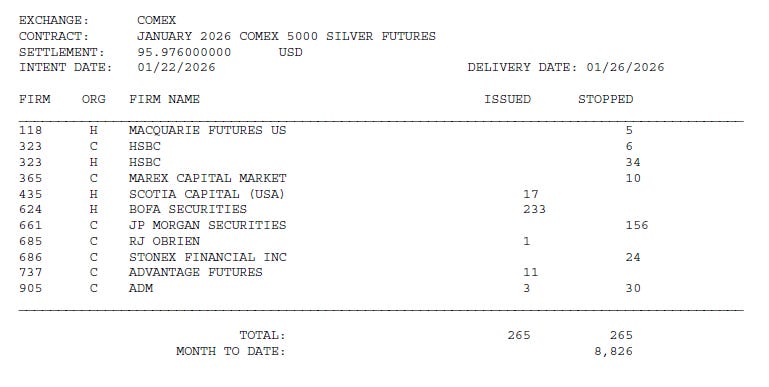
January delivery notices are approaching 9,000 contracts - 45 million ounces - in a month that historically sees about 1,800 contracts. Five times normal. Open interest isn’t dropping as metal gets delivered. It’s rising. Traders are rolling from March into January because they want the metal NOW, not later.
LBMA lease rates are spiking above 8% for one-month silver tells the exact same story. Nobody wants to pay 8% annualized to borrow silver unless they’re desperate for physical delivery right now. London’s vaults are a black box without daily reportings like COMEX, but you can assume they’re basically empty.

All these movements point to an accelerating squeeze. The system was built on a lie that all paper claims are backed by physical metal. They never were. The scheme worked as long as nobody asked for delivery simultaneously. That assumption is failing.
The SLV gamma squeeze adds mechanical fuel to this. When SLV breaks $90, another tranche of call options goes in the money, forcing dealers to hedge by buying more, which pushes price higher, triggering more calls. Feedback loop. The banks know this, which is why they’re desperate to cap the price below that level. Just like they tried at $54, $70, $80, … But they’re running out of ammunition. COMEX raised margins to $32,500 per contract - a 47% spike - calling it a “standard response to volatility”. That’s banker-speak for desperation. Margin hikes shake out the speculators, but when the buyers are industrial users that pay in full or when they’re Asian sovereign entities who need the actual metal, raising these costs just signals fragility.
Options traders shifted from pricing trend risk to gap risk, which is market-speak for “liquidity disappears and price skips levels”. When the smart money prices discontinuous moves instead of smooth climbs, they expect stops to get blown through without any way to fill them!
This is where Michael Oliver’s forecast matters. Oliver nailed the 1987 crash and has been trading markets for 50 years using his Momentum Structural Analysis. His approach measures structural breaks in momentum patterns that signal regime changes. According to Oliver, silver broke into a new regime in November when it shattered its decade-long ceiling versus gold. That ratio breakout was the starting gun for what he calls a “move to new reality” phase where repricing happens in quarters, not years.
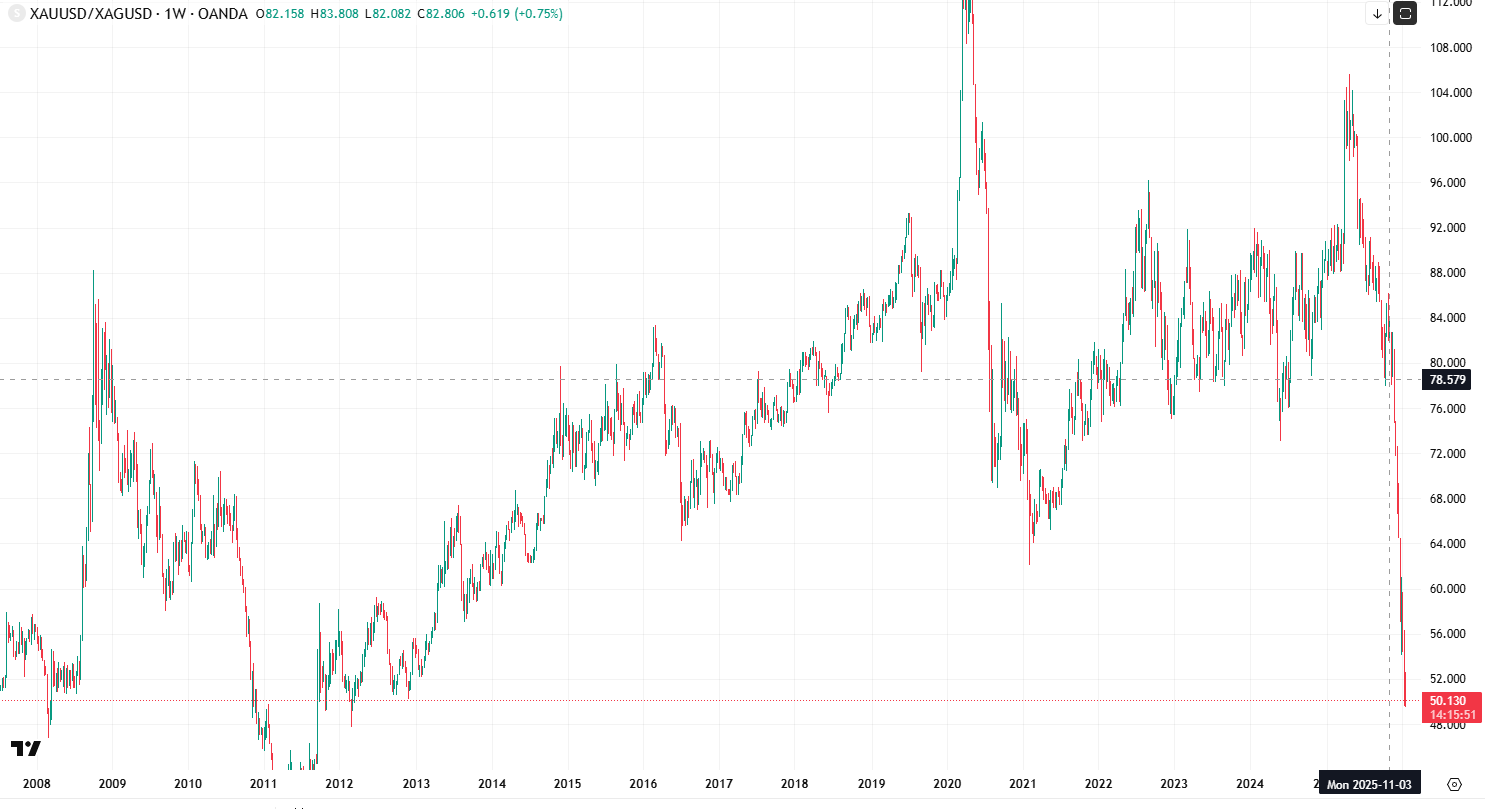
His target? Minimum $200, possibly $300 to $500, in the next handful of months.
The math supports this if you understand what’s happening. If gold repeats the eight-fold moves it made twice before (1976-1980, 2001-2011) and hits $8,000, then silver at historical gold-silver ratios lands you at $248 (3.1% ratio from 2011) or $520 (6.5% ratio from 1980). Oliver’s range sits right in the middle. But even without hitting those historical ratios, silver compressed in a $4-$50 range for half a century creates a LOT of accumulated energy. Artificial suppression through paper markets, ETF creation without full backing, naked shorting by bullion banks who thought they could control price discovery forever. When these barriers break after that kind of compression, Oliver says you get “panic on the upside” - a repricing event where price just goes vertical because there’s no metal available at the current price.
Mining supply grows 1-2% annually. Industrial demand from solar, EVs, AI infrastructure accelerates maybe 10x that much. The supply-demand gap isn’t closing; it’s widening. Geopolitical fragmentation means that gap can’t be papered over with derivatives and swaps anymore. The mining stocks are starting to feel this. Global X Silver Miners ripped 6.24% yesterday. VanEck Gold Miners Junior up 5.49%. These aren’t normal miner moves, and they’re happening before most investors understand what’s unfolding. Oliver says this is exactly how these cycles work - metal moves first, miners catch up as leverage asserts itself, broad participation arrives last when conviction replaces disbelief.
When silver goes from $98 to $150 or $200, miners won’t move 50%. They’ll move 200-300%. That’s leverage. Bank of America targets $110 by H2 2026. Citigroup says $100 by March. Major institutions finally admitting what’s underway because they can’t ignore it any longer.
But even those targets feel conservative to me. They’re thinking in terms of normal market moves. They’re not pricing a scenario where the paper market breaks completely and physical price discovery shifts permanently to Shanghai. They’re not accounting for a world where Japanese capital stops funding US deficits, where China weaponizes strategic metal supply, where central banks flee counterparty risk en masse, where dollar hegemony fractures, and where a gamma squeeze collides with a short squeeze on an exchange that has 15% of the metal needed to cover paper exposure.
That’s not a forecast. That’s Thursday.
Oliver warns that even if silver drops 10-15% during this move, you buy it anyway. In vertical repricing events, corrections happen fast and are buying opportunities, not exit signals. Corrections that used to take months now happen in days, sometimes hours. The system is accelerating because it’s breaking. Japanese bonds revolting. Dollar testing 15-year support. COMEX hemorrhaging metal. Shanghai pulling physical East at expanding premiums. Banks raising margins in panic. Options pricing gap risk.
Silver is trading around $99 this morning.
I’m positioned. The hard work happened when silver was still being mocked at $15, when everyone said $50 was a pipe dream, when the narrative was that metals were dead money. THAT was the time to act. That’s when I started accumulating. Now there’s not much to do except watch this execute exactly as my thesis predicted - debt will be replaced by hard assets. What I didn’t anticipate was the volatility with which the paper market breaks, and the actual physical scarcity.
Watching it happen in real time... It just takes my breath away.
SILVER, BITCHEZ!
I wish I had a way to double capitalize this statement.
I'm also at the phase of seeing vertical increases on my port as well.
Most important thing in such times is to keep a cool head. And to keep looking for stress case scenarios possibilities. You don't want to exist too soon, but you don't want to lose your critical thinking while seeing your gains on your screen. Unrealized gains are...not yet realized.
For silver, the photovoltaic industry is in crisis. There are some articles about temporary closures of factories. It's 10% of global silver demand in jeopardy medium term.
Now of course it's replaced by financial investors right now (and asian retailers). But it's something to monitor in the coming months imo.
I've also found the futures spreads of the Shangai market to be useful to quantify the upward pressure on silver price. It's in fact my main short term signal i use for silver price right now.
As for gold, stress case is just the world becoming a less crazy place in 2026, or governments starting to tackle their deficits, both things which look widly unprobable right now to me.
Happy to be corrected if you're in a disagreement :)