
Honest recount
Mind the exit

As a thanks to my paid subscribers they received this article yesterday. After a day, it opens up for everybody else.
A few days ago I got hyped and told you SpaceX was headed to the moon, involuntarily, on a short-squeeze engineered by Nasdaq’s own rules. Perpetual motion for stocks. The one machine physics swears you can’t build, and Nasdaq apparently built it by accident.

The setup was beautiful in a deranged way: a tiny float, index inclusion that triple-weights it, funds forced to chase phantom shares, the price climbing, the position they owe climbing with it, forever.
Beautiful. And wrong.
After burying myself in spreadsheets and Nasdaq’s own FAQ (yes, they did see this coming), the math just doesn’t carry the moon mission.
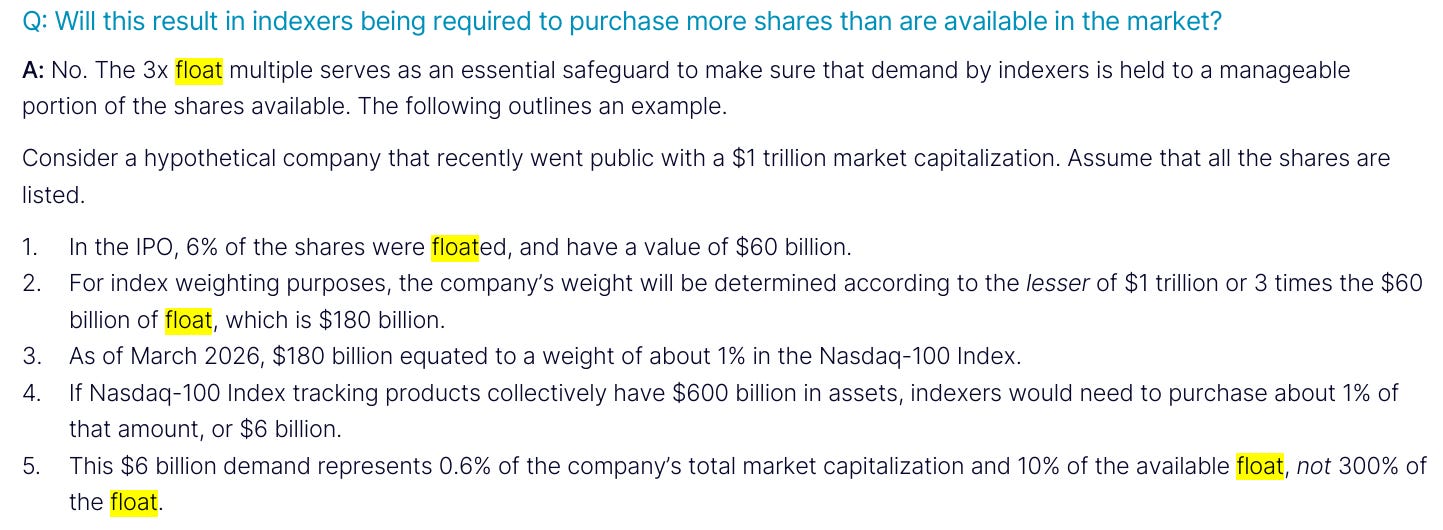
For simplicity, I assume SpaceX at ~$2T, with a 5% float. Here’s the simplified version, but here be dragons - if you spot an error (and I spent days on this plumbing to make sure I got this right), the comment section is right below.
5% of $2T = $100B of float. The index weights it on 3x that → $300B of effective weight.
The Nasdaq-100 constituents are worth somewhere between $33T and $40T all in. So $300B is about a 0.75% weighting.
Roughly $600B actually tracks the index (QQQ, QQQM, JEPQ and friends). 0.75% of that is ~$4.5B of forced buying, against a $100B float. Manageable.
Even at the max 33% weighting (remember 3x equals the full $2T valuation), you get ~$30B. Still coverable.
But it’s enough to move the needle. Not the infinite squeeze I was mooning about. That 3x multiplier is doing some distortion here, but because the Nasdaq pool is relatively small, it’s manageable.
Besides, the float unlocks gradually instead of all at once.
There went my moon. Three days of arithmetic because something felt off.
Nasdaq is absolutely gaming the optics. It’s just a polite distortion, not a perpetual motion machine.
TL;DR: still shady. Not biblical.

So what exactly are we being sold here?
Starlink made a solid $4.4 billion last year. Respectable, genuinely useful business. It’s also the only part that makes money. Then you bolt on xAI, which took $3.2 billion in revenue and turned it into a $6.4 billion operating loss. Two dollars out the door for every dollar in.
Quaint. Most startups have to work really hard to be that bad at math.
Net result: a profitable rocket business and a profitable satellite business still post nearly $5 billion in losses for the year, plus another $4.3 billion in the first quarter alone. “The faster you grow, the faster you go bankrupt” hits different when you’re launching actual rockets.

The valuation? Goldman, the lead underwriter, gets to $1.75 trillion by assuming SpaceX’s AI revenue jumps a hundredfold by 2030. Morgan Stanley, the other underwriter, went one better this week: $3.4 trillion in revenue by 2040. A hundred and eighty times today. About five times what any company on Earth books in a single year.
I read those models. Twice. Didn’t help.
Then, right as I’m wrestling these numbers, Fidelity dropped the velvet rope.
For ten years you needed half a mil in your account to touch pre-IPOs like SpaceX. Reserved for us-knows-us, the accredited, the Masters of the Universe. Then snap, days before the largest share sale in history, the minimum is $2,000. A 99.6% discount, timed perfectly to the week of the sale.
Democratization, they call it. How thoughtful!
Except you don’t reserve 30% of the biggest IPO ever for retail because you ran out of rich people to call. Jamie Dimon personally paraded ~3,500 of JPMorgan’s biggest clients through it. Morgan Stanley runs its own dog-and-pony on Monday. The rich are being worked plenty hard.
The Blind Squirrel calculated two weeks ago that the banks were already 40 to 50% short on demand. So who fills that gap?
Take a gander…
Oh, and the same week, the banks running the deal quietly blocked orders out of mainland China and Hong Kong. Institutions, private-banking clients, retail, ALL of it. SpaceX geo-walled its own website and IPO docs off from both. On the grounds of US arms-export control. Starshield, classified satellites, defence contracts.
Too sensitive for a Hong Kong private banker. But totally fine for your pension at two grand a pop. Check.
And as if that ain’t enough. There’s another catch. A Hotel-California-sized one. When you sell inside 15 days, Fidelity can bar you from future IPOs, even permanently ban you. Robinhood and SoFi run the same rules, just in 30-day versions.
So 30% of the float ends up in hands that are legally handcuffed from selling, through the most violent fortnight the stock will ever have, before any real price has formed. Perfect time for “price discovery”.
I’m sure it’ll be fine.
And after the lockup, you’re betting the passive money shows up on schedule. Some of it will. Nasdaq and FTSE Russell bent the rules to jam it in mid-July, the first slug bought blind.
The S&P 500? Nah.
The S&P 500 was always the real prize - about $16 trillion tracks it, and it needs no weighting tricks to move a price. Just its size.
This week it finally decided to not bend their rules. So it kept the twelve months of seasoning, the real GAAP profits across recent quarters, and no waiver for simply being big.
A company that bleeds nearly $5 billion a year, with xAI still bolted on top, doesn’t really qualify, and won’t for a long time.
It’ll get tossed into the S&P Total Market Index that the big money doesn’t track. The 500 stays shut, a year at minimum, and only if those losses turn… Which, with xAI attached, is not a thing you’d bet a mortgage on.
The other side of the story are the owners of the shares. They can not sell - yet. These lockups eventually expire. By most estimates, by November nearly all of the non-founder stock should be free to trade.
So the timeline runs roughly:
June - retail gets invited to the party and immediately locked in the basement.
July - a modest forced bid from Nasdaq and Russell.
Autumn - the early money starts unlocking huge chunks.
Mid-2027, maybe - the S&P wave, if the losses ever turn. Big if.
The supply arrives right on schedule. The monster demand everyone was counting on got told “see ya next year”.
The early venture money that poured in $11 billion and called it $2 trillion? They’re not buying more. They’re praying you do. This one exit could throw off more money than a decade of normal venture IPOs COMBINED.
And SpaceX is only the opening act.
Anthropic filed confidentially this week and could be public by autumn.
OpenAI is circling a trillion by year-end.
Same thin floats, same rule-bent index rails, same $2,000 welcome mat.
Between them they want north of $200 billion out of a market that did $45 billion in all of last year.
Even Alphabet, sitting on mountains of cash, just sold $85 billion of fresh equity to feed its own AI build. When the cash kings are diluting themselves, you know the pond is getting drained.
And every time the indexes buy the shiny new thing, they have to sell Apple, Nvidia, the lot, to make room. Forced selling into names priced for perfection.
Fun times.
Look, I got the mechanics wrong in the first piece. My bad. But you deserved the full picture.
Those rules are simply not made for us. They get rewritten mid-game. The gates drop at exactly the right moment. And most bagholders will walk in voluntarily, brochure in hand, and won’t notice, until it’s too late, that the doors only swing one way.
They think “FINALLY”. “Now it’s our turn to get RICH”.
But you know better now.
Please be careful.
My other publications:
[Daily Digest] → The news in 5 minutes, without the forty open tabs.
[Portfolio] → What I do with my own money
You may have overstated the degree of bad outcomes that will result from this IPO, but you're still right about the general badness. NASDAQ, FTSE and Fidelity are doing everything they can to lure in the dumb money. There's no getting around the fact that the rule changes force index fund managers to buy shares of a money-losing company at a premium price.
Right now $75 billion in underwriters are shaking in their $1000 dress shoes because not only do they have to float this atrocity, but they have to make sure it doesn't end up next to the Titanic before they need to float the SS Anthropic, and the SS Openai after that. That they have resorted to this level of desperation is telling.
And all of this so Elon could see a 13 digit number on his balance sheet for a little while and Ipomaxx Altman and Amodei.