
Africa's endless exploitation
TL;DR: institutional failures

I got a question from Protect & Survive about what sphere South Africa would end up in when the world would be cut up in a multi-polar way. My answer was a bit blunt but straight to the point: “Generally Africa is exploited by anyone that gets their hands on it. Be it the west, China, or anyone else.”
As I started to think about WHY this was, I had to write this down because it’s not about race, or ethnicity. It’s simply because most humans are inherently weak-willed. Which is reflected in the institutions we create.
Nobody wants to say it out loud, but the question hangs in the air whenever another Chinese mining deal gets signed, whenever another Western company extracts billions while locals starve, whenever another dictator loots the treasury. Why does Africa keep getting exploited?
The comfortable narrative goes like this: centuries of colonialism stripped Africa of its wealth, and the effects linger today. Western nations stole the resources, destroyed the social fabric, and left behind poverty.
Except that story doesn’t explain Zimbabwe.

In 1980, Zimbabwe inherited from Rhodesia a functioning agricultural system that made it the breadbasket of Africa. They had working farms, operational railways, maintained roads, productive mines. The infrastructure was complete. The supply chains were operational. All the pieces were in place.
Twenty years later, a loaf of bread cost 10 billion Zimbabwe dollars.
Hyperinflation peaked at 89.7 sextillion percent in 2008. That’s 89,700,000,000,000,000,000,000%. Prices doubled every 24 hours. People carried wheelbarrows of cash to buy groceries. The banking system collapsed. Manufacturing output fell 29% in 2005, 26% in 2006, 28% in 2007. Unemployment hit 80%.
What happened? Robert Mugabe happened. In the late 1990s, his government seized white-owned commercial farms and redistributed the land. Many new farmers had no agricultural experience. The farms fell into disrepair. Food production collapsed. Export earnings vanished. The government printed money to pay its bills.
Today, 60% of Zimbabwe’s population is food-insecure. Children are stunted from malnutrition. The country once known as Africa’s breadbasket now ranks among the world’s most food-insecure states, alongside war-torn nations.
They weren’t handed ruins. They were handed a functioning economy. They destroyed it themselves.
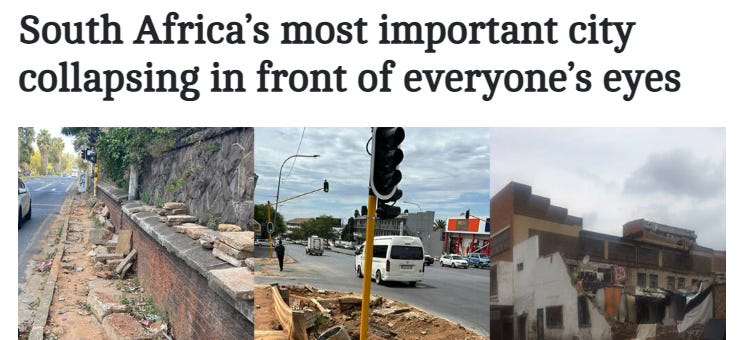
South Africa is following the same path, just moving slower.
Infrastructure is collapsing across the country. Engineers grade it a D - at risk of failure. The electricity grid is held together with duct tape and prayer. Johannesburg, the economic heart of the nation, faces water network failure with 60% of pipes beyond their design lifespan. City Power logged over 800 outage reports in two weeks this past January.
The rail system is a disaster. Transnet can’t maintain freight capacity. ArcelorMittal closed its steel production plant in April due to unstable electricity and failing rail infrastructure. Companies are fleeing.
GDP growth averaged 0.8% over the past decade while population grew at 1.5%. South Africans are getting poorer every year. The country needs to spend R100 billion annually just to return infrastructure to adequate condition. The government debt burden exceeds 75% of GDP, spending over R1 billion per day on debt service. And while electricity generation has improved, the transmission and distribution networks remain dangerously aged - vulnerable to weather and prone to failure under load.
This isn’t colonialism’s fault. The infrastructure was left behind. The mines were operational. The ports functioned. The roads connected the country.
Thirty years of ANC governance turned a first-world infrastructure into third-world ruins. You can’t blame the people who built them. At some point, you have to look at who’s been running things for the past three decades.
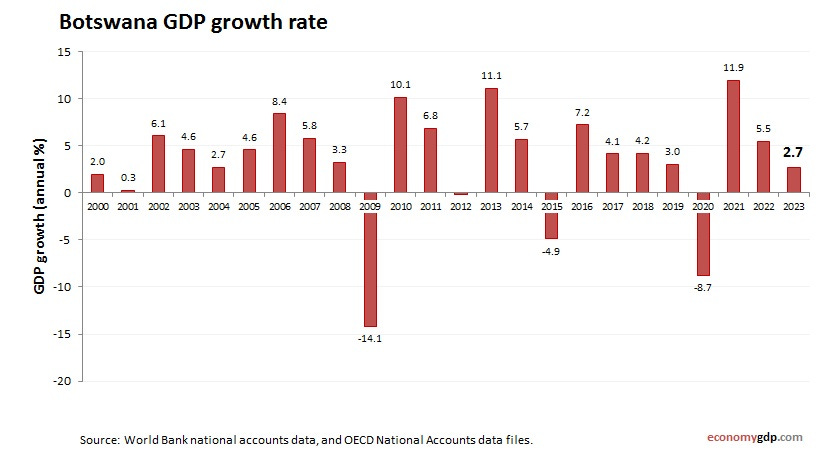
But wait - there’s a country in Africa that proves the opposite is possible.
Botswana.
At independence in 1966, Botswana was desperately poor. GDP per capita ranked among the lowest in the world. The country had 12 kilometers of paved road. Twenty-two citizens had attended university. Nearly the entire population was illiterate. The government relied on British aid for half its budget.

Then they found diamonds. Massive deposits. The kind that make corrupt politicians salivate.
And something unusual happened. The government didn’t loot them.
Botswana formed a 50-50 joint venture with De Beers called Debswana. They managed the diamond wealth through transparent fiscal rules and parliamentary oversight. Diamond revenues went into infrastructure, education, and healthcare - not palace construction and presidential bank accounts.
Between 1966 and 1989, Botswana achieved GDP growth averaging 13% annually. Peak growth exceeded 25% in the early 1970s. The country transformed from one of the world’s poorest to an upper-middle-income nation by 2007.
Today, Botswana ranks as Africa’s third least corrupt country. It maintains the continent’s longest continuous democracy. Property rights are protected. Courts function. The rule of law exists.
Same continent. Same colonial history. Same mineral wealth. Completely different outcome.
The difference? Institutions. Governance. The willingness to build systems instead of looting them.

Botswana didn’t escape the resource curse by accident. They actively fought against it.
Across Africa, resource wealth typically breeds corruption. Oil in Nigeria funds patronage networks and bribery. Diamond wealth in Sierra Leone and Angola fueled civil wars. Minerals in the DRC enriched warlords while citizens starved.
To me this is clear. In countries with weak institutions, natural resources drive corruption, rent-seeking, and conflict. Resource revenues flow to central governments controlled by elites who siphon profits for personal gain. The massive wealth available makes it easy for officials to bribe, intimidate, and consolidate power.
Angola loses $1 billion annually from oil rents to corruption. In Nigeria, oil wealth is linked to persistent corruption and regional conflict. Mining operations across Africa increase bribery - someone within 50 kilometers of a recently opened mine is 33% more likely to have paid a bribe in the past year.
Resource wealth in poorly governed states doesn’t lift people out of poverty. It enriches dictators. It funds private militias. It buys the loyalty of security forces who protect the regime. It allows governments to ignore their citizens because they don’t need tax revenue - they have oil or diamonds or minerals flowing directly into state coffers.
And when the wealth is concentrated in extractable commodities controlled by a few, it becomes a target. Foreign companies know they only need to bribe a handful of officials to access billions in resources. Chinese firms sign sweetheart deals with corrupt ministers. Western corporations negotiate extraction rights that leave locals with nothing.
The exploitation isn’t an external force anymore. It’s invited. Weak institutions create an open door for predatory contracts. When there’s no rule of law, no transparent budgeting, no parliamentary oversight, no independent judiciary - when there’s just a president and his inner circle deciding who gets to extract what - the country becomes a buffet for anyone willing to pay the right people.

The excuses wear thin after a while.
“We weren’t trained to run these systems.”
Botswana started with 22 university graduates. Singapore and Hong Kong worked with colonial administrators during the transition. Both managed just fine post-independence. More than fine - they thrived.
“The borders were artificial, the ethnic tensions insurmountable.”
Botswana has ethnic diversity. So does Malaysia, another resource-rich success story. The difference is they built inclusive institutions instead of tribal patronage networks.
“We needed time to develop capacity.”
It’s been sixty years since most African nations gained independence. South Korea went from war-torn poverty in 1953 to a developed economy today. China transformed from Maoist disaster to global superhouse in four decades. Time is not the limiting factor.
The uncomfortable truth is that governance matters more than resources. Institutions matter more than inheritance. What you do with what you’re given determines outcomes.
Zimbabwe was handed a functioning agricultural system. They destroyed it through land seizures and hyperinflation.
South Africa inherited first-world infrastructure. They let it rot through corruption and incompetence.
The DRC sits on trillions in mineral wealth. Citizens live in extreme poverty while elites pocket mining revenues.
Venezuela has the world’s largest oil reserves. People literally ate zoo animals during the crisis.
Having resources means nothing if you can’t build systems to manage them. Having infrastructure means nothing if you lack the institutional capacity to maintain it. Being independent means nothing if you replace colonial administrators with kleptocratic dictators.

The pattern repeats across the continent with depressing regularity.
A country gains independence. Initial optimism. Perhaps a charismatic leader promising transformation. Then the institutions weaken. Corruption spreads. Infrastructure decays. The economy stagnates. Foreign exploitation increases because weak governments make easy targets for extractive deals.
Someone always benefits. Usually a small elite. Presidential families get rich. Ministers award contracts to relatives. State enterprises become piggy banks. The military gets paid to keep the system intact.
Meanwhile, the majority stays poor. Roads crumble. Electricity fails. Water systems break. Schools lack teachers. Hospitals lack medicine. The tax base can’t grow because the economy can’t grow because the infrastructure can’t support growth.
And the cycle continues. Another generation born into dysfunction. Another wave of exploitation by whoever shows up with cash and a willingness to bribe the right officials.
This is why Africa stays poor. Not because the West stole everything. Not because colonialism destroyed some mythical pre-colonial paradise. Not because the resources are gone.
Africa stays poor because too many African governments are spectacularly bad at governance.
They can’t maintain roads. Can’t keep the lights on. Can’t protect property rights. Can’t enforce contracts. Can’t stop corruption. Can’t build competitive industries. Can’t educate their populations. Can’t provide basic services.
And when you can’t do those things, you stay vulnerable. Vulnerable to Chinese debt traps. Vulnerable to Western mining companies offering pennies on the dollar. Vulnerable to domestic strongmen who loot with impunity. Vulnerable to civil wars over resource control.
Botswana shows the alternative is possible. Strong institutions, transparent governance, rule of law, long-term planning. It’s not rocket science. It’s just incredibly hard when you’re competing with people who want to steal everything not nailed down.

The question isn’t whether Africa can develop. Obviously it can. The question is whether African governments will build the institutions required for development.
That means establishing rule of law. Real courts. Independent judiciaries. Property rights that can’t be seized on a presidential whim.
It means transparent budgeting. Citizens need to see where resource revenues go. No more off-book accounts. No more mysterious transfers to foreign banks.
It means merit-based bureaucracies instead of tribal patronage. Hire people who can actually do the job, not your cousin who bought your election campaign.
It means allowing private enterprise to compete with state monopolies. Let businesses operate without needing to bribe officials at every turn.
It means accepting that sometimes the technocrat knows more than the politician. Let experts run the utilities, manage the ports, maintain the railways.
This isn’t colonialism. This isn’t Western imperialism. This is basic governance. The stuff that works everywhere it’s tried. The stuff Botswana figured out sixty years ago.
But most African governments won’t do it. Too many people profit from the current system. The president’s inner circle. The military brass. The party faithful who get government contracts. The officials who take bribes. They all benefit from weak institutions and captured states.
Change threatens their position. Transparency threatens their wealth. Rule of law threatens their immunity. Meritocracy threatens their family networks.
So the exploitation continues. Not because the West is uniquely predatory. Because weak institutions invite predators. A lion doesn’t feel guilty about eating a gazelle. A mining company doesn’t feel guilty about bribing a minister. That’s just the nature of things when one party is strong and the other is weak.
Want to stop the exploitation? Build stronger institutions. Want to stop being poor? Build functioning systems. Want to stop being a target? Stop being an easy mark.
The resources are there. The potential is there. The question is whether the will is there to do what’s necessary.
Based on the past sixty years, I’m not optimistic.
The CIA funds rebel groups that will sell out the people once they gain power. Color revolutions get funded. Good leaders get assassinated. Business-friendly dictators get installed in their place. The US teaches their military how to kill "communists". The US sells the dictators weapons. The IMF loans money to the country using their resources as collateral. The IMF requires that "changes" get made as a requirement for the loans. US companies exploit local labor and extract resources. This playbook has been run hundreds of times. It is how the US empire operates.
Can this be resisted? Yes, but it must be acknowledged as a corrupting influence on Africa.
Botswana sold out to the West long ago.
Those who defy the West face engineered famines, sanctions etc - Uganda is a clear recent example. Tucker Carlson has a video on it - Why Are You Gay? https://www.youtube.com/watch?v=NiTILBSU8tM
A list of relevant news articles on Botswana
----
Botswana government lies exposed as diamond mine opens on Bushman land
https://www.survivalinternational.org/news/10410
Thu, 04 Sep 2014 23:34 UTC
The Bushmen were told they had to leave the reserve soon after diamonds were discovered in the 1980s, but the Botswana government has repeatedly denied that the illegal and forced evictions of the Kalahari Bushmen - in 1997, 2002 and 2005 - were due to the rich diamond deposits. It justified the Bushmen's evictions from the land in the name of "conservation".
The mine opening has also exposed Botswana's commitment to conservation as window dressing. The government falsely claims that the Bushmen's presence in the reserve is "incompatible with wildlife conservation," while allowing a diamond mine and fracking exploration to go ahead on their land.
The government continues its relentless push to drive the Bushmen out of the reserve by accusing them of "poaching" because they hunt their food. The Bushmen face arrest, beatings and torture, while fee-paying big game hunters are encouraged. The government has also refused to reopen the Bushmen's water wells, restricted their free movement into and out of the reserve, and barred their lawyer from entering the country.
Meanwhile, organizations such as Conservation International continue to laud President Khama for his environmental credentials and turns a blind eye to his human rights abuses.
---
1.6 billion people worldwide forced to pay bribes
Thu, 26 Feb 2015 21:03 UTC
A major study has looked at bribery levels across the world and reached a disappointing conclusion: a total of 1.6 billion people worldwide - nearly a quarter of the global population - are forced to pay bribes simply to gain access to everyday public services.
However, Professor Rose says that: "'Within every continent, there are major differences in the percentage of people annually paying bribes. In Africa, the range is between 63 percent in Sierra Leone and 4 percent in Botswana; in the European Union, which has the goal of upholding the rule of law, there were 29 percent paying a bribe in Lithuania and fewer than 1 percent reporting bribing a British public official."
Morals are hard to map
Europe's low rates for individuals having to bribe officials for services should not necessarily be taken as a sign of moral superiority. Professor Rose explains that: "The European contribution to global corruption is in the bribes that multi-national corporations pay to political elites to obtain 'big bucks' contracts for such things as building dams or supplying military aircraft."
"However," he added, "survey data shows this is not the case. The great majority of people in every country think that bribery is wrong. They pay bribes because the alternative is doing without health care or a better education for their children."
---
Botswana sells fracking rights in one of Africa's largest conservation areas to UK energy company
https://sputnikglobe.com/20151202/drilling-shale-gas-africa-1031137944.html
Wed, 02 Dec 2015 17:58 UTC
Botswana's government has recently sold the rights to the British Karoo Energy company to frack for shale gas in the Kgalagadi transfrontier park, the Guardian newspaper reported Wednesday.
The Kgalagadi park is among Africa's largest conservation areas.
According to the article, top park officials, as well as conservationists, were not informed of the rights sale, which has caused concern about the possible negative effects drilling could have on the site.
---
IEP report found only 10 nations around the world are not at war
Fri, 10 Jun 2016 03:06 UTC
A troubling report by the Institute for Economics and Peace found a mere ten nations on the planet are not at war and completely free from conflict. According to the Global Peace Index 2016, only Botswana, Chile, Costa Rica, Japan, Mauritius, Panama, Qatar, Switzerland, Uruguay and Vietnam are free from conflict.
---
Botswana deports US pastor after he calls for 'killing gays'
Tue, 20 Sep 2016 14:15 UTC
Steven Anderson has been banned from entering the U.K., Botswana and South Africa due to his homophobic views.
U.S. pastor Steven Anderson was arrested and deported from the African nation of Botswana after calling for gay people to be killed, President Ian Khama told Reuters Tuesday, just days after the pastor was banned from neighboring South Africa over his anti-gay views.
---
U.S. opposed UN resolution condemning death penalty for same-sex relations
https://www.losangelesblade.com/2017/10/02/u-s-opposes-un-resolution-death-penalty-sex-relations/
Mon, 02 Oct 2017 22:23 UTC
---
African countries renew push to lift ivory trade ban
https://www.theeastafrican.co.ke/news/africa/Southern-Africa-renews-push-to-lift-ivory-trade-ban/4552902-5106250-pk4wvcz/index.html
Wed, 08 May 2019 16:19 UTC
---
Landmark case: Botswana decriminalizes gay sex
Tue, 11 Jun 2019 00:00 UTC
Botswana became the latest country to decriminalize gay sex on Tuesday, a landmark case for Africa, as the High Court rejected laws punishing it with up to seven years in prison.
"Botswana is the ninth country in the past five years to have decriminalized consensual same-sex relationships," U.N. spokesman Stephane Dujarric said.