
A viral option-OI chart
TL;DR: can't find it

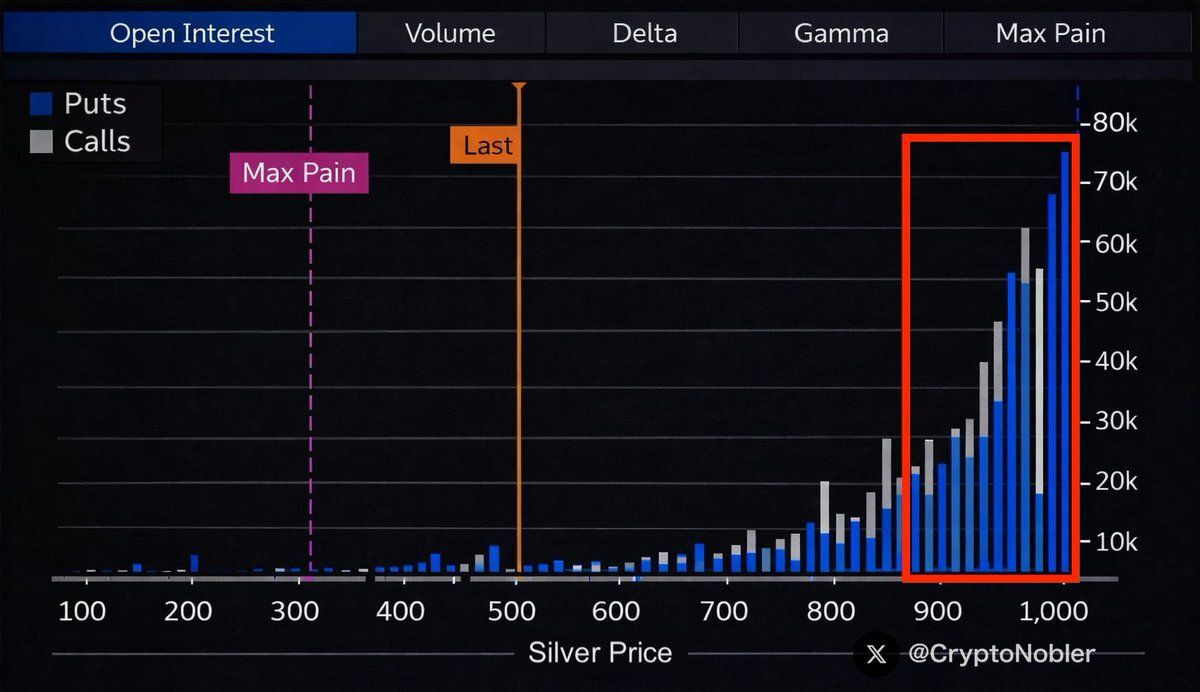
A chart went viral-ish yesterday showing massive open interest in $900 and $1,000 silver call options for December 2026. “Insiders buying $900 silver calls”. Silver’s at $75. That’s a 12x move in 9 months.
About a million people saw it. Someone wrote about it in the comments… The engagement machine did its thing.
One problem though.
Those strikes don’t exist. At ALL!
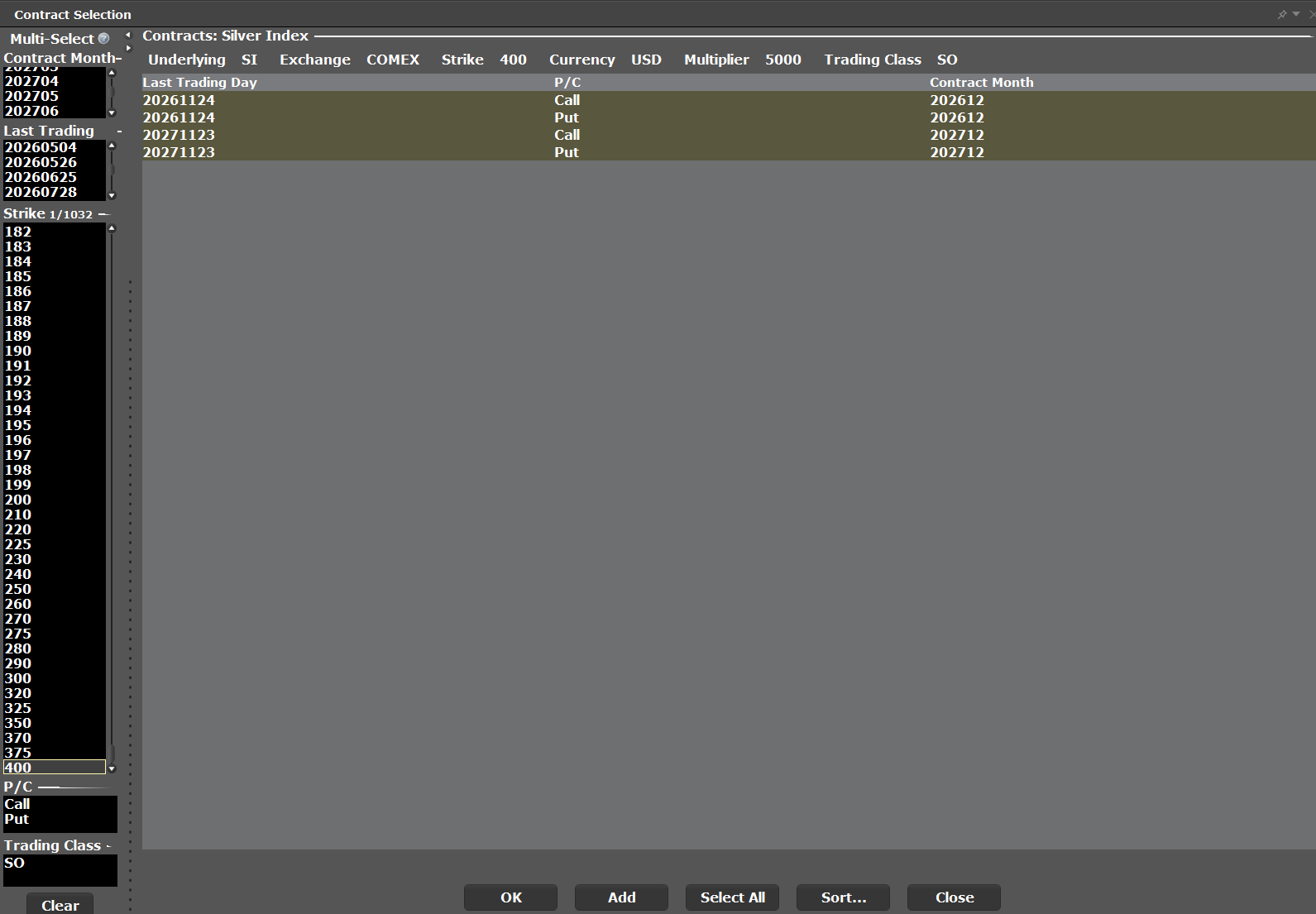
COMEX silver options for December 2026 max out at $400. Pull up the CME contract specifications yourself - the strike list goes $370, $375, $400, and then it stops. No $500. No $900. Certainly no $1,000. The chart is sourced from... somewhere. Not the exchange where silver options actually trade.

This is the part that truly irritates me about financial Twitter and why it’s such a labour to weed out the chaff. Despite the drop not too long ago, silver STILL has a real story. Structural deficits seven years running. LBMA inventories under enormous stress. Shanghai premiums consistently running 10% over spot. Industrial demand eating into available supply. Bombs dropping (yep, there is silver in there!). The physical market is tight and is getting tighter by the day.
You don’t have to fabricate options data to make the bull case.
But fabrication is easier than analysis. A chart with no source attribution, showing strikes that don’t exist on any exchange, spawns a narrative about “insider buying” within hours. Nobody asks who these insiders are, what CFTC filing shows their positions, or why anyone with inside knowledge of a 12x move would express that view through exchange-listed options where every trade is reported. They wouldn’t. That’s not how any of this works.
Plus, most people sharing this chart clearly don’t understand open interest (OI): it doesn’t tell you which direction those options are leaning. High OI just means that a position is taken at that strike price. It doesn’t tell you if it was a sale or a buy. Premium collection by market makers selling lottery tickets to retail looks identical to “insider buying” on an OI chart. 100% identical.
The real damage isn’t to people who fall for it. Even I did for a second. Until I went to check these strikes.
It’s to the silver thesis itself. Every “trust me bro” insider claim gives skeptics and mainstream financial media an easy way to dismiss the entire silver community as conspiracy theorists who can’t read a spec sheet. The people who benefit from silver staying underpriced love nothing more than silver bulls discrediting themselves.
Always check your sources. Pull up the actual contract specs. And maybe don’t take options analysis from accounts with “Crypto” in the handle at face value. Just sayin’.
But let’s play the game.
What if those strikes were real?
Say those $900-$1,000 strikes existed and someone had built 50-70k contracts of open interest at each strike for December 2026. What would that actually mean for the silver market?

First, the mechanics. When a dealer sells a call option, they’re short volatility. To stay neutral, they need to delta hedge - buy the underlying as the price moves toward the strike. At $75 spot, a $900 call has almost no delta. Maybe 0.02. The dealer barely notices it exists.
But delta isn’t static. It changes with price. That rate of change is gamma, and gamma is what makes options dangerous for the people who sold them.
As silver moves from $75 toward $200, $300, $400, those calls start waking up. Delta creeps from 0.02 to 0.05 to 0.10. Doesn’t sound like much until you multiply it by 50,000 contracts at 5,000 ounces each. That’s 250 million ounces of notional exposure. At a delta of 0.10, dealers need to be long 25 million ounces of silver just to hedge that one strike.
COMEX vaults currently hold about 76 million registered ounces and 328 million total (registered plus eligible). So at a lazy 0.10 delta, one strike eats a third of all registered silver. Manageable, sure. Now remember the chart showed massive OI at $900, $950, $1,000 and everything in between. Six, seven, eight strikes. At 0.10 delta across all of them, you’re looking at hedging demand that rivals the entire registered inventory. And that’s the *lazy* delta. We haven’t even gotten to the scary part yet.

Because it accelerates. The move from delta 0.10 to 0.30 happens faster than the move from 0.02 to 0.10. At 0.30, a single strike needs 75 million ounces of hedging (50k contracts x 5k ounces x 0.3). That’s the entire registered stockpile. For one strike. I need a drink.
Every dollar higher forces more buying. The buying pushes the price higher. Which forces more buying. This is the gamma squeeze feedback loop, and with 9 months of time value on those options, there’s no natural theta decay to break the cycle quickly.
The pull is asymmetric too. Max pain on that chart sat around $300 - over $200 below the “last” (spot) price. For max pain to exert gravitational force, silver would need to collapse 75%. Max pain gravity works best in the final days before expiry when time value evaporates. With 9 months left, it’s essentially irrelevant.
The call wall, on the other hand, would be only $125 away. Close enough that any sustained rally - a COMEX delivery squeeze, a physical market dislocation, another spike to $120 like earlier this year. Anything could start this gamma feedback loop. Silver doesn’t even need to reach $900. It just needs to move toward it fast enough that dealer hedging becomes self-reinforcing.
With December 2026 expiry, those options carry substantial time value even far out of the money. Dealers can’t sit and wait for decay to save them. Any volatility spike reprices the entire chain, forcing hedging adjustments across every strike simultaneously.
Now how would you as a buyer actually position for something like this? There are a few ways to play strikes like these, and they tell very different stories about what you think is going to happen.
Outright buy the $900 call. The pure moonshot. You pay a small premium (these are deep OTM with 9 months of runway, so not dirt cheap but not ruinous either) and you need silver to absolutely rip past $900 for intrinsic value, or just move violently enough toward it that volatility expansion makes the option worth more than you paid. Maximum loss: your premium. Maximum gain: unlimited. This is the “I think silver is going to do something historic” trade. You don’t need $900 silver to profit - a move from $75 to $150 with a vol spike would reprice these dramatically. But you’re fighting theta every day, and if silver chops sideways for 6 months, your premium bleeds to zero.
Outright buy the $1,000 call. Same thesis, cheaper ticket, worse odds. You’re further from the money, so delta is even lower and you need an even bigger move to get paid. The advantage is position sizing - you can buy more contracts for the same capital. This is the lottery ticket version of the lottery ticket.
Bull call spread: buy $900, sell $1,000. Now we’re talking. You buy the $900 call and sell the $1,000 call against it. The sold call offsets a chunk of your premium, making the trade cheaper to enter. Your maximum profit is capped at $100 of intrinsic value per ounce (the distance between strikes) minus the net premium paid, but your breakeven is lower than the outright $900 call. This is the “I think silver could go parabolic but I want to define my risk tightly” trade. The tradeoff: if silver goes to $1,500, you leave everything above $1,000 on the table. On COMEX silver options at 5,000 ounces per contract, that $100 spread is worth $500,000 per contract at max value. Not bad for a defined-risk position.
Bear call spread (sell $900, buy $1,000). This is the reverse - you sell the $900 call and buy the $1,000 call as protection. You collect premium upfront and profit as long as silver stays below $900 at expiry. The $1,000 call caps your loss if you’re wrong. This is the “these strikes are absurd, I’ll take free money from the dreamers” trade. You’re betting against a 12x move. Statistically, you’re right the vast majority of the time. But when you’re wrong, you’re spectacularly wrong - and the bought $1,000 call is the only thing between you and a margin call. This is likely what a significant chunk of that OI actually represents, if any of it were real. Someone has to be on the other side of every trade, and selling deep OTM calls to retail is one of the oldest premium-harvesting strategies in the book. Don’t be a mark!
Ratio call spread: buy 1x $900, sell 2x $1,000. You buy one $900 call and sell two $1,000 calls. The extra sold call can make this a zero-cost or even credit trade. You profit between $900 and $1,100 (roughly), with max profit at $1,000. But above $1,100 you start losing money - and above that, you’re effectively naked short one call with unlimited risk. This is the “I think silver could spike but not that much” trade. Clever, until silver goes vertical. Then you’re dead.
So if the chart were real, the answer to “what pulls the price more” is simple. The call wall wins. Overwhelmingly. It has massive OI, it’s relatively closer to spot than max pain, and the hedging mechanics create positive feedback as price approaches. Max pain has negligible OI and requires an improbable collapse to matter.
But the chart isn’t real. And the actual COMEX chain tops out at $400, which with silver at $75, is still a 5x bet with real delta hedging implications of its own. That’s aggressive enough to be interesting without needing to invent strikes that the exchange doesn’t list.
The bull case for silver is dramatic enough on its own.
We no need fairy tales for that.